
Why do multi agent LLM systems fail (and how to fix)- 2026 Guide
Research shows multi-agent LLM systems fail 41 to 86% of the time in production, and this guide breaks down the 14 root-cause failure modes with fixes that actually work at scale.

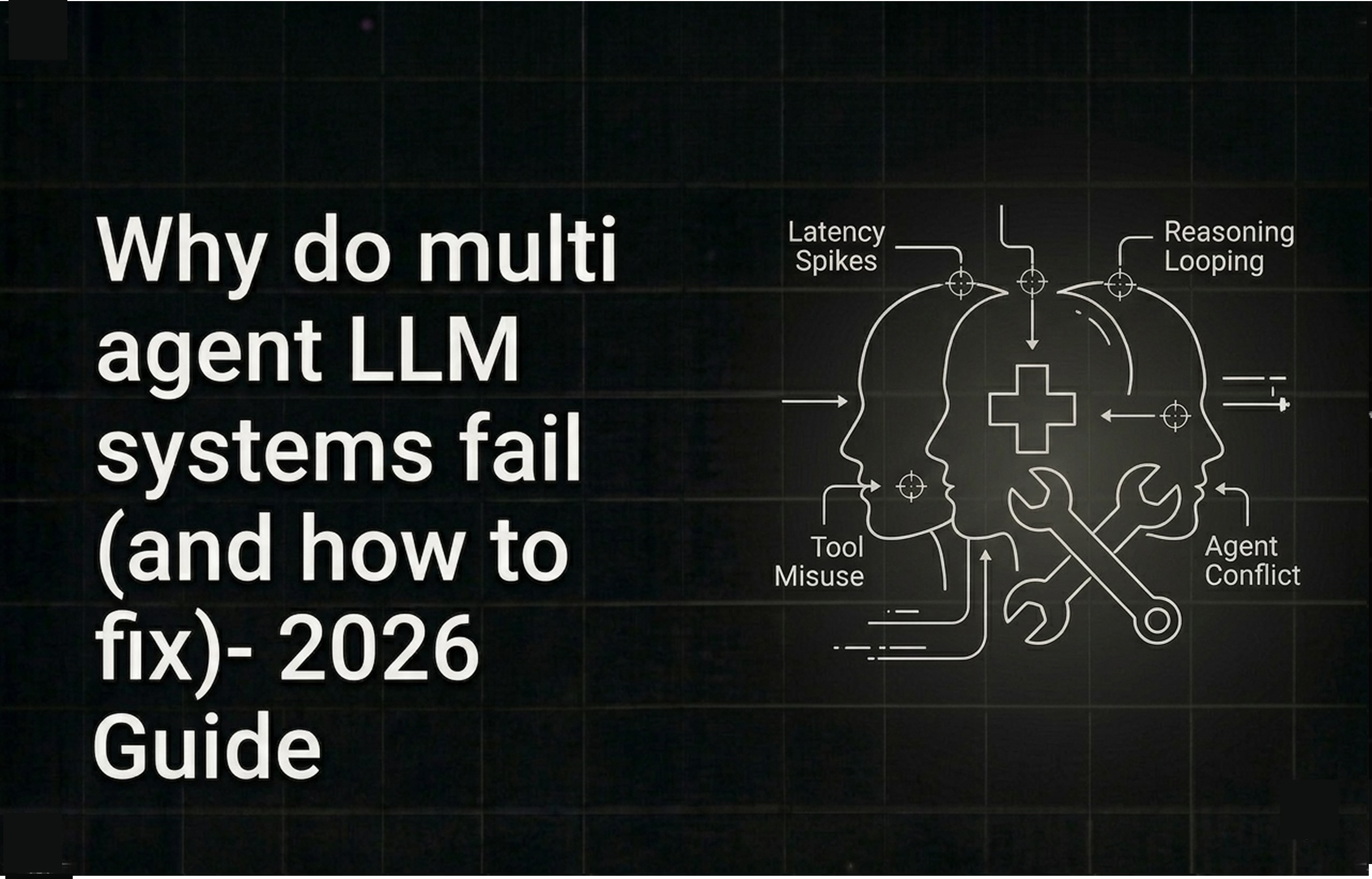
Multi-agent systems sound great on paper. You split a task across specialized LLM agents, let them collaborate, and get better results than any single model could produce alone. That is the pitch.
The reality is different. According to research from UC Berkeley, multi-agent LLM systems fail between 41% and 86.7% of the time on standard benchmarks. That is not a minor reliability gap. It is a fundamental engineering problem that every developer building multi-agent architectures needs to understand before shipping to production.
This article breaks down exactly why these systems break, what the research says about root causes, and what you can do about it with specific, actionable fixes grounded in real data.
What Are Multi-Agent LLM Systems?
A multi-agent system (MAS) uses multiple LLM-powered agents that each handle a specific role within a larger workflow. Instead of one model doing everything, you assign agents as planners, coders, reviewers, or executors. They communicate, share outputs, and coordinate to complete a task.
Popular frameworks include CrewAI, AutoGen, MetaGPT, LangGraph, and AG2. The core idea is sound: divide complex work across specialists, just like a human team. But unlike human teams, LLM agents cannot ask clarifying questions mid-task, cannot read between the lines, and cannot self-correct when coordination breaks down.
The MAST Failure Taxonomy: What the Research Actually Shows
The most rigorous study on this topic is the MAST (Multi-Agent System Failure Taxonomy) research by Cemri et al. The team analyzed over 1,600 annotated execution traces across 7 popular multi-agent frameworks and identified 14 distinct failure modes. Six expert annotators achieved a Cohen’s Kappa agreement score of 0.88, indicating strong consensus.
These 14 failure modes cluster into three categories. Specification and System Design issues account for roughly 41.8% of all failures, covering problems like task misinterpretation, ambiguous role definitions, poor decomposition, duplicate agent roles, and missing termination conditions. Inter-Agent Misalignment accounts for about 36.9%, including communication breakdowns, context loss during handoffs, conflicting outputs, and format mismatches between agents. Task Verification and Termination failures make up the remaining 21.3%, spanning premature task ending (6.2%), incomplete verification (8.2%), and incorrect verification (9.1%).
The key finding is this: roughly 79% of all failures come from specification and coordination problems, not infrastructure or model-level issues. Developers tend to focus on picking the right model or optimizing tokens. The data says the real problems are upstream, in bad specs and broken coordination.
Failure Category 1: Specification and System Design Issues
This is the biggest category, responsible for nearly 42% of all observed failures. These problems happen before agents even start talking to each other.
Here is what goes wrong in practice. Agents receive vague role definitions like “you are a researcher” without clear boundaries, leading to overlapping scope or missed tasks. Poor task decomposition is another culprit: a planner slices complex tasks into sub-tasks that are either too granular or too broad, leaving downstream agents stuck with unfinishable work. Without explicit limits on iterations, time, or output format, agents enter loops or produce incompatible outputs. And when nobody defines what “done” looks like, agents keep iterating and burning tokens indefinitely.
The fix requires discipline rather than cleverness. Treat agent specifications like API contracts. Define roles with JSON schemas. Make every constraint explicit. Specify exact input/output formats, success criteria, and stop conditions.
Here is a minimal example of what a production-grade agent spec looks like:
json
{
  "agent_id": "code_reviewer_01",
  "role": "Reviews Python code for security vulnerabilities and style violations",
  "capabilities": ["static_analysis", "security_audit"],
  "constraints": {
    "max_iterations": 3,
    "timeout_seconds": 120,
    "output_format": "json"
  },
  "success_criteria": ["all_critical_issues_flagged", "report_generated"]
}
This is not exciting work. But the MAST data shows that specification clarity alone eliminates the single largest category of system failures.
Failure Category 2: Inter-Agent Misalignment
Even when individual agents are well-specified, things fall apart when they try to work together. Inter-agent misalignment accounts for about 37% of failures and is the hardest category to debug.
The problems show up in several ways. Context collapse happens as agents pass messages and context windows fill up. Agents lose track of earlier decisions and start contradicting themselves or each other. Format mismatches occur when a planner assigns steps in YAML but the executor expects JSON, and these small mismatches cascade into workflow-breaking errors. Conflicting objectives emerge when two agents think they own the same resource, making conflicting changes without awareness of each other’s work. And natural language ambiguity is inherent because LLM agents communicate through unstructured text. Unlike microservices with strict API contracts, agents rely on the other agent correctly interpreting their output.
The solution is structured communication protocols. Anthropic’s Model Context Protocol (MCP) enforces schema-validated messages using JSON-RPC 2.0, giving every message an explicit type, validated payload, and clear intent. Block, Replit, and Sourcegraph have deployed MCP for production multi-agent workflows.
You also need explicit resource ownership. Every file, API endpoint, or database table should belong to exactly one agent. When two agents think they control the same resource, you get conflicts that are nearly impossible to trace.
Failure Category 3: Task Verification and Termination
The third category covers what happens at the end of a workflow. Or rather, what does not happen.
Premature termination accounts for 6.2% of failures, where an agent declares “done” before completing all sub-tasks. No or incomplete verification makes up 8.2%, where the system skips quality checks on the final output entirely. And incorrect verification is the most common at 9.1%, where a verifier agent approves output that does not meet the original requirements.
These numbers add up to about 23.5% of all failures. Roughly one in four failures happens because the system did not check its own work properly.
The MAST researchers found that single-pass verification is not enough. Systems need multi-level verification: unit checks at the agent level, integration checks across outputs, and final validation against original task requirements.
The most effective pattern is the independent judge agent. This separate agent evaluates the final output using an isolated prompt, separate context, and predefined scoring criteria. It should not share context with producing agents, or it risks joining the same collective reasoning loop.
PwC reported a 7x accuracy improvement (from 10% to 70%) after implementing structured validation loops with judge agents in their CrewAI-based code generation pipeline.
Infrastructure Failures: Visible but Less Common
Infrastructure issues like rate limits, context window overflows, and cascading timeouts account for roughly 16% of failures. They cause the most visible outages but rank last in actual impact.
Still, you need to handle them. Circuit breakers should isolate misbehaving agents before they consume the entire token budget or trigger cascading failures. Token budgets need hard limits per agent per task because an agent in an infinite loop can burn thousands of dollars of API credits in minutes. Structured logging with correlation IDs on every message, tool call, and plan step is essential because without it, debugging a multi-agent failure across 15,000+ lines of trace is nearly impossible. And graceful degradation means that if one agent fails, the workflow should recover or fall back to a simpler path instead of collapsing entirely.
Picking the Right Framework
The framework you choose matters, but less than your implementation discipline.
AutoGen (Microsoft) works best for research tasks and adaptive workflows. It uses dynamic message passing and excels at flexible agent negotiation and role allocation.
CrewAI is strongest for business processes and team-like structures. It uses role-based orchestration and is the fastest to implement. PwC reported 7x accuracy gains with this framework.
LangGraph fits enterprise systems that need auditability. It uses graph-based state management and offers built-in checkpointing, state persistence, and conditional logic.
The framework choice should match your coordination pattern. CrewAI gets you to production fastest for structured workflows. LangGraph gives better control for enterprise compliance. AutoGen offers the most flexibility for research tasks. Regardless of framework, the fundamentals stay the same: strict specifications, structured communication, independent verification, and proper monitoring.
How Future AGI Can Help You Fix It
If you are building or debugging multi-agent LLM systems, you need observability that goes beyond basic logging. Future AGI provides an evaluation and observability platform built for exactly this kind of problem.
Future AGI’s TraceAI, built on OpenTelemetry, captures every LLM call, tool invocation, and agent handoff as structured spans. You can reconstruct full execution paths and pinpoint where failures start. The platform lets you evaluate agent outputs automatically, scoring them at each step with built-in or custom metrics to catch verification failures before they cascade. You can compare workflow configurations by testing multiple multi-agent setups side by side and identifying the winner based on accuracy, latency, and cost. And instead of reading thousands of lines of trace data, Future AGI surfaces the specific failure point and provides actionable feedback for root cause analysis.
Conclusion
Multi-agent LLM systems fail for predictable, well-documented reasons. The MAST taxonomy gives us a clear framework: 42% of failures come from bad specifications, 37% from coordination breakdowns, and 21% from weak verification.
The fixes are not glamorous. Write better specs. Enforce structured communication. Add independent validation. Monitor everything. These are distributed systems engineering fundamentals applied to LLM agents. Start with the specification layer, build in observability from day one, and treat every agent interaction as something that needs to be traced, evaluated, and verified.
FAQs
1. Why do multi-agent LLM systems fail more often than single-agent setups?
Every time agents hand off work to each other, you open the door to context loss and conflicting outputs. Multi-agent LLM systems carry coordination overhead that a single model simply does not have. The research confirms this: 79% of multi-agent failures trace back to bad specifications and broken coordination between agents, problems that do not exist when one agent handles everything alone.
2. What are the most common failure modes in multi-agent systems?
The MAST taxonomy identifies 14 failure modes across three categories: specification and design issues at 41.8%, inter-agent misalignment at 36.9%, and verification failures at 21.3%. The worst offenders are task misinterpretation, context collapse, incorrect verification, and agents terminating before the job is actually finished. Solid system design up front prevents most of these.
3. How can I debug failures in a multi-agent LLM pipeline?
Set up structured tracing before anything else and assign correlation IDs to every message and tool call so you can reconstruct the full execution path when something breaks. Future AGI provides OpenTelemetry-based observability that captures every LLM call and agent interaction as structured spans, letting you track down the exact point of failure instead of guessing from error logs.
4. What is the MAST failure taxonomy for multi-agent systems?
MAST stands for Multi-Agent System Failure Taxonomy, built by UC Berkeley researchers who analyzed over 1,600 execution traces across 7 popular multi-agent frameworks. It categorizes failures into three top-level categories and 14 specific modes, making it the first data-backed framework for understanding why multi-agent LLM systems actually break. The full dataset and LLM annotator are open source on GitHub.
5. How do you prevent context collapse in multi-agent LLM systems?
Context collapse happens when agents lose track of earlier decisions because the context window is saturated. The fix is to stop passing raw conversation history between agents and use structured summaries and explicit state objects that capture key decisions instead. Schema-validated protocols like Anthropic’s MCP also keep messages tight and prevent information from degrading across handoffs.
6. Can multi-agent systems outperform single-agent LLMs in production?
They can, but only with the right engineering investment. PwC demonstrated a 7x accuracy improvement using a multi-agent CrewAI setup for code generation. The requirement is that multi-agent systems need tight specs, structured coordination protocols, and independent verification layers to actually beat a single model. Without those safeguards, the coordination overhead will drag results down instead of lifting them up.