
Understanding LLM Observability & Monitoring
Explore LLM observability tools that monitor AI behavior, detect issues like hallucinations and latency spikes, and ensure reliable performance in production workflows.

LLM Observability refers to the tools and practices used to monitor, understand, and optimize the behavior of Large Language Models (LLMs) during inference in production and development pipelines. Just as traditional software observability tracks servers, databases, application health, and other key metrics, LLM observability makes AI systems transparent, enabling teams to catch issues like hallucinations, latency spikes, retrieval failures, or broken tool calls before they escalate to any further system failure.
In a modern logistics network, it's not enough to know truck routes; we need real-time tracking of their locations, supply chains, and any delays and their solutions. In the same way, LLM systems involve multiple “moving parts” (prompts, embedding generation, tool invocations) that need constant visibility. As AI becomes part of a core infrastructure layer in many products, LLM observability is no longer just an option; it becomes critical to ensure reliability, cost control and user trust, just like monitoring supply chains is crucial for a successful logistics operation
Why LLM Observability is Needed?
Unlike traditional software systems, LLM applications are:
Non-Deterministic: Their outputs are unpredictable as they work on massive neural network architecture that are probabilistic in nature
Opaque: The architecture of the models trained on massive amounts of data are black box in nature; we can’t actually seek what’s happening inside
Multi-Component: There can lot of small components working together to create a bigger picture (for example RAG, Tools, etc.)
UX-Faulty: Since their outcomes are nondeterministic, they can actually break the User Experience
The LLM Observability Landscape
The field of LLM observability has evolved rapidly, with several tools emerging to address different aspects of monitoring and debugging LLM applications. Popular solutions include LangSmith, which focuses on tracing and debugging LangChain applications, and other specialized tools for monitoring specific aspects, like token usage or response quality.
Future AGI stands out in this landscape by providing a comprehensive, easy-to-integrate observability solution with state-of-the-art evaluation capabilities. Our platform combines the best features of existing tools while adding unique capabilities like:
Advanced evaluation frameworks for multiple data modalities
Seamless integration with popular LLM frameworks
Real-time monitoring and alerting
Version management and A/B testing
Refer to our LLM Observability Cookbook to begin practical implementation.
In the following sections, we'll explore how to implement LLM observability using Future AGI's platform, covering everything from basic setup to advanced features.
4.1 Key Features Provided By Future AGI
Future AGI offers a python SDK for observability, which is known as TraceAI. This library is designed to tackle enterprise-grade LLM Observability. It not only enables detailed logging and tracking of model behavior but also integrates Evaluations of your existing workflows for smooth and effective monitoring.
4.1.1 Real-Time Tracing Dashboard
Visualize Every LLM Interaction as a trace. Whether it's a simple chatbot session, a multi-turn chain, or a multi-agent interaction system with tool calling and embedding retrievals. You get a full end-to-end view of your application. This allows you to
Step-by-step execution breakdown
Model version tracking
Prompt-template correlation
4.1.2 Custom Evaluation Framework:
Future AGI provides you a variety of Evaluations for your generative AI use cases; they are not limited to text but are also included for other data modalities, including vision and audio. Some example evaluation metrics that are easy to set up are:
Factual Accuracy for Ground Truth Evaluations
Deterministic Evaluations For your custom needs
Analyzing Audio Quality for your synthetic speech outputs
4.1.3 Failure and Anomaly Detection:
Get Automatic alerts when something goes wrong - be it prompt injection, latency issues, or failure in evaluations. These alerts can be integrated well through the dashboard, which can be integrated into your Emails and Other Platforms.
4.1.4 Version Management:
Track how changes to prompts, context templates, or tool configurations affect outputs. A/B test different versions and get insight into:
Response quality shifts
Cost and latency changes
Evaluation Metrics
Setting up LLM Observability With FutureAGI
The setup process is very developer-friendly and easy to integrate. Future AGI offer support for variety of popular frameworks like Langchain, LlamaIndex, Anthropic, Openai etc.
Step 1: Installing The Dependencies
Future AGI's Observability feature can be found in the python packages of traceAI relevant to each framework; for the langchain below is the relevant library
pip install traceAI-langchainStep 2: Export your API Keys in environment variable
You can get your keys after creating the futureagi account at app.futureagi.com
FI_API_KEY = "xxxxxxx000xxxxx"
FI_SECRET_KEY = "xxxxx0000xxxxxxx"
Step 3: Register Your Pipeline
Future AGI Provides two Observability Features: prototype and Observe Here's when you have to select one of them
Prototype: When you are building your application and experimenting on workflows, enabling you to do version management and A/B Testing to optimize your workflow. This is where you can create various prototypes of your applications that you plan to deploy
Observe: When you are ready to deploy your application and want to log the real-time user interaction to have further analysis.
Below is an example snippet for Observe
from traceai_langchain import LangChainInstrumentor
from fi_instrumentation import register
from fi_instrumentation.fi_types import (
    EvalName,
    EvalSpanKind,
    EvalTag,
    EvalTagType,
    ProjectType
)

trace_provider = register(
project_type = ProjectType.OBSERVE
session_name = "Observe_Session"
project_name = "Name_Of_The_Project"
)

LangChainInstrumentor().instrument(trace_provider=trace_provider)
And now you are ready to have your LLM application being traced, monitor, debugged by checking the dashboard of Future AGI
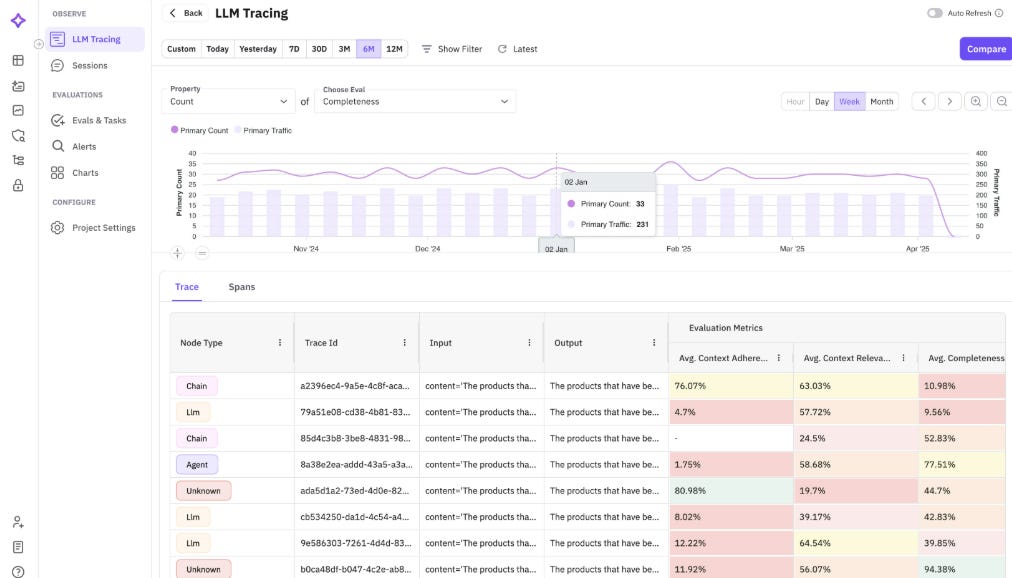
A sample dashboard of Future AGI showcasing the Observe Feature and deriving the necessary insights for the LLM Application through the power of LLM Observability
Now that we have deployed our application and we are continuously monitoring the workflow, we can start running evaluations for the data to identify the potential risks of failure or enhance the user experience by analyzing the data and optimizing our AI Workflows. FutureAGI provides custom evaluations suited to your use case, which are very easy to set up.
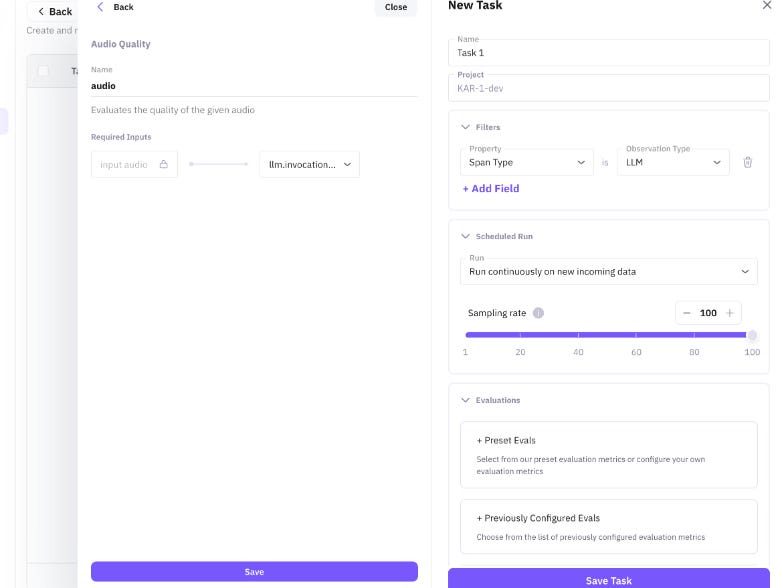
To configure Evals you can use Evals & Tasks Section to Setup Eval easily for your live or historical data
Go to the Evals & Tasks section
Click on Create New Task
Write the name of your task and select the spans you want to Evaluate on (Say LLM)
Select the data (Either Historical or Live )
Select one of the Evaluations you want to perform
Best Practices for Implementing LLM Observability
Whether you're deploying a simple chat assistant or a complex multi-agent system, following these best practices will ensure your observability setup is effective, scalable, and actionable.
6.1 Start integration of Observability into early stages of development
Don't wait until production. Enable tracing and evaluation during the development phase to:
Debug workflows while building
Evaluating Your Test Cases
Benchmarking on various datasets
FutureAGI provides a feature named Prototype suited for exactly this case.
6.2 Instrument All Key Components
Make sure you're tracing across the entire LLM pipeline:
Prompt generation logic
Context retrieval (for RAG)
Tool/agent calls
Final response generation
Gaps in tracing = blind spots in debugging. Use auto-instrumentation when available and fall back to manual spans for custom steps.
6.3 Set Up Alerts for Critical Failures
Define alerts and thresholds for:
Latency spikes
Empty or malformed responses
Tool failure rates
Retrieval mismatches
Route alerts to Slack, PagerDuty, or your CI/CD pipeline to close the loop with engineering teams.
6.4 Prioritize Cost + Latency alongside Quality
High-quality outputs don't justify runaway costs or unresponsive apps. Use observability to track:
Token usage
Response time per step/component
Cost per session or user interaction
This helps you optimize performance–cost–quality trade-offs.
6.5 Review and Refine Regularly
Make observability reviews part of your model improvement cycles. Ask:
Are our alerts meaningful?
Are we evaluating the right spans?
What are our top failure modes this month?
Iterating on observability is how you stay ahead of model regressions and data drift.
6.6 Use a Single Source of Truth for All Traces
Centralize traces, logs, and metrics in one unified dashboard (like Future AGI). Avoid context switching between logs, metrics, and model outputs; it slows down debugging and invites missed signals.
Conclusion
LLM observability is essential for developing reliable, transparent, and scalable language applications in today's rapidly evolving AI landscape. By instrumenting your pipelines , tracing each prompt and response and each event, you gain insights to diagnose issues swiftly and can optimize your workflows to achieve perfection
As models and use cases grow in complexity, whether you’re running a simple chatbot or orchestrating a multi-agent RAG system, the clarity provided by a unified observability platform becomes invaluable. With real-time dashboards, custom evaluation frameworks, and robust version management, You’ll not just detect anomalies but also continuously improve your product’s quality, aligning your AI outputs with business goals and user expectations.
Embrace LLM Observability today to transform your AI’s black box into a more transparent engine. Fortify your applications against unexpected failures, and unlock the full potential of generative AI in production.