

AI vendors keep releasing what they call “the next big thing,” but which LLM APIs actually deliver? Which one scales smoothly without surprise bills at month’s end?
Picking the right LLM API matters more than ever. GPT-5 launched at $1.25 per million input tokens with a 400K context window. Claude Opus 4.5 cut costs by 66% compared to its predecessor while scoring 80.9% on SWE-bench. DeepSeek R1 offers reasoning capabilities at just $0.55 per million input tokens. And xAI’s Grok 4.1 Fast gives you a 2 million token context window at $0.20 per million input tokens.
Prices now range from $0.10 per million input tokens on Gemini Flash-Lite to $15 on Claude Opus 4.1. Context windows span from 128K to 2 million tokens. This guide compares 11 major LLM API platforms to help you pick the right one for your project.
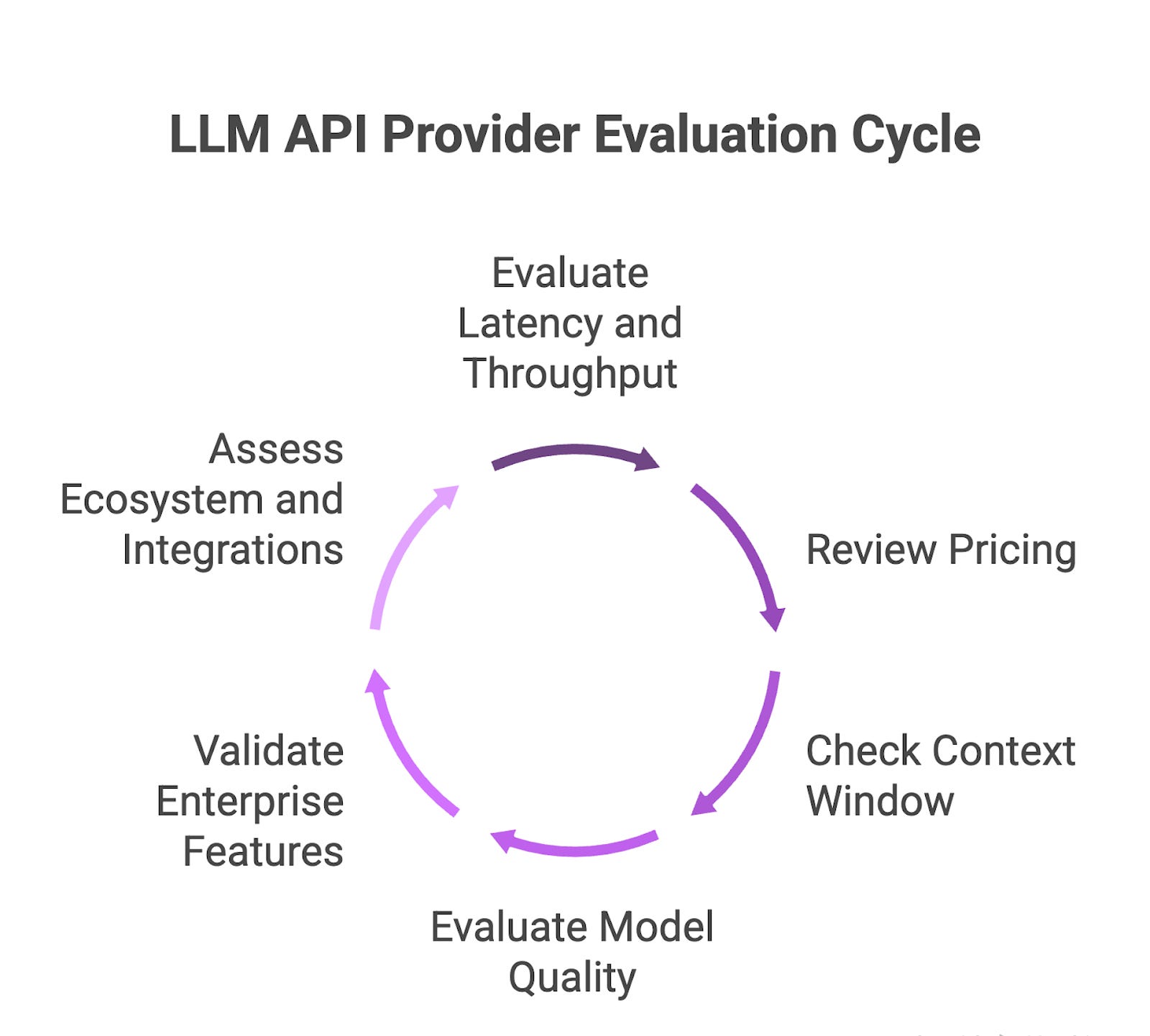
How to Evaluate an LLM API Provider
Before committing to any API, consider speed, cost, context size, accuracy, enterprise features, and integration options. Here are six practical evaluation criteria:
Latency and throughput. Check time-to-first-token and tokens-per-second rates. Top systems now hit sub-0.5 second first token and exceed 1,000 TPS in production benchmarks.
Pricing. Review input and output token costs. Some providers charge $0.10 per million input tokens while others hit $15 for the same volume. Understand whether pricing is flat or pay-as-you-go.
Context window. Most providers now offer 128K to 256K tokens. Some go further: GPT-4.1 supports 1 million tokens, Gemini 2.5 Pro handles 1 million tokens, and Grok 4.1 Fast pushes to 2 million tokens.
Model quality. Check benchmark scores for reasoning, coding, summarization, and factual accuracy. Claude Opus 4.5 leads on SWE-bench at 80.9%. DeepSeek R1 scores 87.5% on AIME math problems.
Enterprise features. Verify SLAs, compliance certifications (SOC 2, HIPAA, ISO), and dedicated infrastructure options for security and uptime requirements.
Ecosystem and integrations. Support for MCP (Model Context Protocol), SDKs, and plugin systems reduces integration effort with existing tools.
Deep Dives: Top 11 Providers
1. OpenAI
OpenAI continues leading the LLM API market with GPT-5 and GPT-5.1, serving ChatGPT and enterprise deployments through general-purpose, reasoning, and cost-optimized models.
Models
GPT-5.1 is the flagship reasoning model with a 400K token context window. It supports configurable reasoning effort and handles coding and agentic tasks. Priced at $1.25 input and $10 output per million tokens.
GPT-4.1 is their smartest non-reasoning model with a 1 million token context window. Costs $2 input and $8 output per million tokens. It runs 40% faster than GPT-4o with 80% lower costs per query.
GPT-5-mini offers budget pricing at $0.25 input and $2 output per million tokens with solid reasoning performance for cost-sensitive applications.
Strengths
GPT-4.1 scores 54.6% on SWE-bench verified coding. GPT-5.1 handles extended agentic workflows with configurable reasoning depth. The API supports multimodal inputs (text, image, audio) in a single call. Cached input tokens get 75-90% discounts.
2. Anthropic
Anthropic’s Claude models power conversation, coding, and autonomous agent tasks through their API, Amazon Bedrock, and Google Vertex AI. The Claude 4.5 series brought significant price reductions alongside performance gains.
Models
Claude Opus 4.5 is the most capable model scoring 80.9% on SWE-bench. Priced at $5 input and $25 output per million tokens, it represents a 66% reduction from Opus 4.1’s $15/$75 pricing.
Claude Sonnet 4.5 delivers balanced performance at $3 input and $15 output per million tokens. It supports a 1 million token context window with tiered pricing for inputs over 200K tokens.
Claude Haiku 4.5 is the fastest option at $1 input and $5 output per million tokens with near-frontier performance for high-volume tasks.
Strengths
Extended thinking lets Claude reason through complex problems with a configurable token budget. All 4.5 models support this feature. Safety guardrails meet AI Safety Level 2-3 criteria. The batch API provides 50% discount, and prompt caching saves 90% on repeated content.
3. Google Gemini
Google’s Gemini series offers cutting-edge multimodal capabilities, massive context windows, and integration with Google Search for grounding.
Models
Gemini 3 Pro Preview is the newest flagship at $2 input and $12 output per million tokens for contexts under 200K. Supports a 1 million token context with 2 million coming soon.
Gemini 2.5 Flash delivers best price-performance at $0.15 input and $0.60 output per million tokens. Optional thinking mode costs $3.50 output for enhanced reasoning.
Gemini 2.5 Flash-Lite is the lowest cost at $0.10 input and $0.40 output per million tokens while handling 1 million token context.
Strengths
Native multimodal support handles text, voice, images, and video in a single request. Google Search grounding provides real-time citations and reduces hallucinations. Free tier offers up to 1,000 requests daily for most models.
4. Microsoft Azure OpenAI
Azure OpenAI Service delivers OpenAI models through Microsoft’s enterprise cloud with VPC isolation, regional data zones, and compliance certifications.
Strengths
99.9% uptime SLA for token generation. Compliance with ISO, SOC, and HIPAA requirements. Regional data residency across 27 Azure regions plus US and EU Data Zones. Pricing matches OpenAI’s direct API with regional variations. Provisioned Throughput Units (PTUs) guarantee capacity for high-volume applications.
5. Amazon Bedrock
Amazon Bedrock provides a unified API for foundation models from Anthropic, Meta, Mistral, Cohere, and Amazon without managing infrastructure.
Models
Access Claude, Llama 3.2 (from $0.0001/1K tokens for 1B to $0.002/1K for 90B models), Mistral (7B at $0.15/$0.20 per million, Large at $8/$24), Cohere Command, and Amazon Nova models.
Strengths
Serverless inference scales automatically. Bedrock Knowledge Bases enable RAG workflows. Agents connect models to APIs and databases. Batch mode provides 50% discounts. Consolidated billing across all foundation models simplifies cost management.
6. Cohere
Cohere’s Command API focuses on retrieval-augmented generation and tool use with extensive context windows and fine-tuning options.
Models
Command A offers 256K token context optimized for complex agentic tasks and multilingual support. Command R costs $0.15 input and $0.60 output per million tokens with 128K context. Command R7B runs on edge devices at $0.0375/$0.15.
Strengths
Optimized for RAG with reliable tool integration. Handles 10+ languages with consistent latency. Achieves over 500 tokens per second on optimized hardware. Fine-tuning available from $3 per million training tokens.
7. Mistral AI
Mistral provides open-weight models under Apache 2.0 through its API or self-hosted on your infrastructure.
Models
Mistral Medium 3 delivers near-proprietary performance at $0.40 input and $2 output per million tokens with 131K+ context through sliding window attention. Mistral 7B beats larger 13B and 34B models at $0.25 per million. Codestral Embed outperforms OpenAI’s embeddings on code retrieval.
Strengths
Apache 2.0 licensing allows unlimited commercial use, modification, and distribution. Grouped-Query Attention extends context to 131K+ tokens with minimal memory overhead. Self-hosting eliminates API costs beyond infrastructure.
8. Together AI
Together AI offers a serverless platform running 200+ open-source and partner models through a single API.
Models
Llama 4 Maverick (Meta’s 400B parameter model) offers 1 million token context at $0.27/$0.85 per million tokens. DeepSeek-R1-0528 scores 87.5% on AIME at $7 per million. Qwen 2.5-7B provides 131K context at $0.30/$0.80.
Strengths
Instant serverless endpoints get you from idea to demo in minutes. Model library covers conversation, code, vision, and embeddings. GPU cluster rentals start at $1.75/hour for H100 SXM.
9. Fireworks AI
Fireworks AI delivers serverless inference with industry-leading speed using their FireAttention engine. SOC 2 Type II and HIPAA compliant.
Strengths
FireAttention delivers up to 12x faster long-context inference and 4x improvements over vLLM using FP16/FP8 optimization on H100 hardware. Multi-cloud GPU orchestration across 15+ regions ensures availability. New accounts get $1 free credits.
10. xAI Grok
xAI’s Grok models feature real-time X (Twitter) data access and the industry’s largest context window at 2 million tokens.
Models
Grok 4 costs $3/$15 per million tokens with 256K context, scoring 65 on intelligence benchmarks. Grok 4.1 Fast delivers near-frontier performance (64 score) at just $0.20/$0.50 with 2 million token context.
Strengths
2 million token context eliminates chunking for document analysis. Built-in web and X search provide real-time data. Automatic prompt caching reduces costs. New users get $25 free credits plus $150/month through data sharing.
11. DeepSeek
DeepSeek offers high-performance reasoning at rock-bottom prices through open-source models. R1 competes with GPT-4 on math, reasoning, and coding while costing 90% less.
Models
DeepSeek R1 costs $0.55 input and $2.19 output per million tokens with chain-of-thought support. DeepSeek V3.2 is their 671B parameter MoE model. R1 Distill Llama 70B is the lightest at $0.03 per million.
Strengths
Mixture-of-Experts architecture activates only 37B of 671B parameters per query. MIT license allows full commercial use with open weights. Self-hosting eliminates API costs entirely.
Best-Fit Use Cases
Startups and SMBs: Together AI, Mistral, and DeepSeek offer the best cost-to-performance ratios. Together AI’s pay-as-you-go model works well for variable traffic patterns. Mistral’s Apache 2.0 license eliminates licensing costs entirely, and you can self-host to control infrastructure spend. DeepSeek R1 gives you GPT-4 level reasoning at 90% lower cost, making it practical for early-stage products with limited budgets.
Enterprises: Azure OpenAI provides 99.9% uptime SLAs with ISO, SOC, and HIPAA compliance for regulated industries. Amazon Bedrock offers unified billing and AWS security integration. Both support private endpoints and role-based access controls. Anthropic’s Claude meets strict safety requirements for customer-facing applications where guardrails matter.
Multimodal applications: GPT-5.1 handles text, audio, and image in single requests without juggling multiple APIs. Fireworks AI optimizes multimodal inference across GPUs for real-time applications. Gemini 3 Pro excels at native multimodal understanding with support for video analysis and audio processing.
Long-context processing: Grok 4.1 Fast leads with 2 million tokens, eliminating chunking strategies for document analysis. Gemini 2.5 Pro and GPT-4.1 handle 1 million tokens for processing entire codebases or book-length documents. Claude Sonnet 4.5 supports 1 million with tiered pricing above 200K tokens.
Research and fine-tuning: Cohere’s fine-tuning API adapts models for domain-specific tasks starting at $3 per million training tokens. Hugging Face provides access to 60,000+ models for self-hosted deployment. Mistral’s open weights enable custom training without license restrictions.
Trends and What’s Next
Price wars continue. DeepSeek’s 90% cheaper pricing puts real pressure on proprietary providers. Claude 4.5 cut costs 66% from the previous generation. OpenAI’s GPT-5 series undercuts earlier GPT-4 pricing. Expect further reductions as next-gen chips improve throughput and competition intensifies across providers.
Context windows keep growing. Grok 4.1 Fast hit 2 million tokens. Gemini promises 2 million soon. This shift enables processing entire codebases, book-length documents, and extended conversations without complex chunking strategies or memory management workarounds.
Reasoning models mature. Extended thinking, chain-of-thought, and configurable reasoning budgets let developers trade cost for accuracy on complex problems. Both Claude and OpenAI now offer reasoning effort controls, so you can dial up compute for hard tasks and save money on simple ones.
On-device inference expands. Lightweight models like Mistral 7B, Llama 3.2 1B, and Gemini Flash-Lite run on edge devices and smartphones. Federated inference keeps data local while maintaining quality, opening new possibilities for privacy-sensitive applications.
Agentic capabilities emerge. Tool use, web search, and autonomous task completion move from demos to production deployments. xAI built search directly into Grok. OpenAI and Anthropic offer MCP support for seamless tool integration. Expect agents to become standard features rather than experimental add-ons.
Conclusion
The right LLM API balances context capacity, cost, and speed for your specific use case. Ultra-fast endpoints like Gemini Flash respond quickly at higher per-token rates. Budget options like DeepSeek and Mistral save significant money but may need more tuning for latency-sensitive applications.
Start with a pilot. Run an A/B test between two providers using identical prompts. Measure real-world latency, token usage, and output quality on your actual workloads. The results will reveal which API fits your needs better than any published benchmark.
Mix and match. Use cheaper models for classification, routing, and simple tasks. Reserve expensive models like Claude Opus or GPT-5.1 for complex reasoning. Most production systems benefit from a tiered approach that matches model capability to task difficulty.
Watch costs closely. Prompt caching, batch processing, and smart context management can cut bills by 50-90%. Enable caching for repeated system prompts. Use batch mode for non-urgent workloads. Monitor token usage to catch inefficient prompts before they drain your budget.
Plan for change. Prices drop every few months. New models launch regularly. Build abstraction layers so you can switch providers without rewriting your application code.
FAQs
What’s an LLM API? An LLM API is a service interface that lets applications send text prompts to a large language model and receive generated responses. It integrates NLP capabilities like conversation, summarization, and code completion through HTTP requests without requiring you to host the model yourself.
Can I switch providers mid-project? Yes. Use an abstraction layer like LangChain, LiteLLM, or a custom SDK wrapper to hide provider-specific calls. This lets you swap models or providers without rewriting core application logic.
How do I benchmark cost vs. performance? Calculate cost per million tokens divided by achieved throughput (tokens per second). Run parallel tests that log latency and per-token rates on your actual workloads. Consider both input and output token costs since the ratio varies by task.
Are open-source models production-ready? Several open-source LLMs including Mistral 7B, Llama 3.x, and DeepSeek R1 match proprietary performance on many tasks and power production RAG systems and chatbots today. Run pilot testing and set up monitoring to catch drift or quality issues before they affect users.
References
Based on my research for this article, here are the sources:
OpenAI Pricing - https://openai.com/api/pricing/ - Official pricing page for GPT-5, GPT-5.1, GPT-4.1 models
OpenAI Models Documentation - https://platform.openai.com/docs/models - Model specifications including GPT-5.1, GPT-5.2, context windows
Anthropic Claude Pricing - https://platform.claude.com/docs/en/about-claude/pricing - Official Claude API pricing for Opus 4.5, Sonnet 4.5, Haiku 4.5
Google Gemini API Pricing - https://ai.google.dev/gemini-api/docs/pricing - Gemini 3 Pro, 2.5 Flash, Flash-Lite pricing
Google Gemini Models - https://ai.google.dev/gemini-api/docs/models - Model specifications and capabilities
xAI Grok Models and Pricing - https://docs.x.ai/developers/models - Grok 4, Grok 4.1 Fast pricing and context windows
Amazon Bedrock Pricing - https://aws.amazon.com/bedrock/pricing/ - Multi-model pricing for Claude, Llama, Mistral on AWS
DeepSeek API Pricing - https://api-docs.deepseek.com/quick_start/pricing - R1 and V3 model pricing
Vertex AI Pricing - https://cloud.google.com/vertex-ai/generative-ai/pricing - Google Cloud Gemini pricing
Price Per Token - https://pricepertoken.com
Aggregated pricing data for OpenAI, Anthropic, xAI, DeepSeek models (updated February 2026)
CostGoat Claude API Calculator - https://costgoat.com/pricing/claude-api - Claude pricing breakdown and batch discounts
CostGoat Gemini API Calculator - https://costgoat.com/pricing/gemini-api - Gemini pricing tiers and context caching
MetaCTO Anthropic Pricing Guide - https://www.metacto.com/blogs/anthropic-api-pricing-a-full-breakdown-of-costs-and-integration - Extended thinking and caching costs
MetaCTO Google Gemini Pricing Guide - https://www.metacto.com/blogs/the-true-cost-of-google-gemini-a-guide-to-api-pricing-and-integration - Gemini 3 Pro and Flash pricing comparison
AI Free API Claude Pricing Guide - https://www.aifreeapi.com/en/posts/claude-api-pricing-per-million-tokens - Detailed Claude 4.5 series breakdown
AI Free API Grok Pricing Guide - https://www.aifreeapi.com/en/posts/xai-grok-api-pricing - Grok free credits and tool pricing
Finout OpenAI Pricing 2026 - https://www.finout.io/blog/openai-pricing-in-2026 - ChatGPT Plus, Enterprise, and API cost analysis
Finout Azure OpenAI Pricing - https://www.finout.io/blog/azure-openai-pricing-6-ways-to-cut-costs - Azure PTU and regional pricing
IntuitionLabs LLM API Pricing Comparison - https://intuitionlabs.ai/articles/llm-api-pricing-comparison-2025 - Cross-provider comparison data
IntuitionLabs Claude Pricing - https://intuitionlabs.ai/articles/claude-pricing-plans-api-costs - Subscription and API cost breakdown
Helicone LLM API Providers Guide - https://www.helicone.ai/blog/llm-api-providers - Provider comparison for DeepSeek R1 and others
Google Developers Blog - https://developers.googleblog.com/en/gemini-25-flash-lite-is-now-stable-and-generally-available/ - Gemini 2.5 Flash-Lite specifications
DeepInfra DeepSeek Models - https://deepinfra.com/deepseek - DeepSeek V3.2 and R1 hosting details
Anthropic API Pricing - https://www.nops.io/blog/anthropic-api-pricing/ - Claude model tier breakdown
Solid breakdown. One thing that's missing from most API provider comparisons like this is the proxy/aggregator layer that's emerged. Services like Synthetic give you access to multiple open-weight models (DeepSeek, Qwen, Kimi, etc.) through a single Anthropic-compatible API for a flat $30/month. No per-token billing.
I did a proper rate limit comparison across Claude Pro, Claude Max, and Synthetic and the maths is quite telling https://reading.sh/how-to-get-3x-claude-rate-limits-for-30-a-month-1d3fdb8658df. For solo developers who don't need the actual Claude models specifically, you can get 3x the throughput of Claude Pro for $10 more per month.
Curious whether you're planning to cover the proxy/aggregator space in a follow-up? It's becoming a legitimate alternative for developers who need high throughput but can't justify the $100-$200/month Max tiers.