

Speech-to-text is no longer just a transcription tool. It is the front door of every voice agent, real-time captioning system, and conversational AI product shipping today. If your STT layer drops words, adds latency, or chokes on accents, everything downstream breaks. The LLM gets garbage input. The user hears a delayed, confused response. Your product loses trust.
The problem is that every provider claims best-in-class accuracy and sub-100ms latency. Those numbers almost always come from clean studio audio with native English speakers. Real production audio has background noise, international accents, and cellular compression. The gap between marketing claims and actual performance can be enormous.
This guide compares 10 leading speech-to-text providers using independent benchmark data, real pricing, and practical criteria that matter when you are building for production. Whether you are wiring up a voice agent over WebSocket or processing thousands of hours of call center recordings, this breakdown will help you pick the right STT API for your stack.
What Makes a Speech-to-Text Provider “Best”?
There is no single best STT provider. The right choice depends entirely on what you are building. A voice agent that needs sub-200ms streaming latency has different requirements than a medical transcription pipeline that prioritizes domain-specific accuracy.
Here is what actually matters during evaluation.
Latency profile. Does your app need real-time streaming via WebSocket, or is batch processing acceptable?
Accuracy on your data. A 5% WER on LibriSpeech benchmarks means nothing if your users have heavy accents and noisy environments.
Language and accent coverage. Supporting 100+ languages on paper is different from delivering low WER across all of them.
Pricing structure. The per-minute rate is just the starting point. You need to factor in your real volume, plus extras like diarization and redaction that quietly inflate the invoice.
Developer experience. SDK quality, documentation depth, and how quickly you can go from a fresh API key to a working integration without fighting the tooling.
The vendor that wins on one axis often loses on another. Deepgram leads on latency. ElevenLabs Scribe leads on multilingual accuracy. Open-source models like Whisper give you full control but require infrastructure. Your job is to find the right tradeoff for your specific use case.
Six Metrics That Separate Production-Grade STT from Demo-Grade STT
Before diving into provider comparisons, you need to know which numbers to trust and which to ignore.
1. Word Error Rate (WER)
WER counts substitutions, insertions, and deletions against a ground-truth transcript. Lower is better, but context matters enormously. A provider reporting 5% WER on clean LibriSpeech audio might hit 15–20% on noisy call center recordings. Always ask: what dataset was used, what normalization was applied, and does it match your production audio profile?
2. Streaming Latency (Time to First Partial)
For real-time voice agents, this is the most critical metric. It measures how quickly you receive the first transcribed word after audio is sent over a WebSocket connection. The target for voice-to-voice interactions is under 800ms total round-trip (STT + LLM + TTS combined), which gives your STT layer a budget of roughly 150–300ms. Anything above 500ms makes conversations feel sluggish.
3. Accuracy Under Real Conditions
Throw your messiest audio at it recordings with background noise, speakers who are not native English, and jargon specific to your industry. A system that scores 95% on clean English can drop to 85% on accented speech with background noise. Independent benchmarks from Artificial Analysis and the Hugging Face Open ASR Leaderboard give you a more honest picture than vendor-reported numbers.
4. Cost Per Audio Hour
You can pay as little as $0.0145/min with Deepgram or as much as $0.016/hour on Google Cloud’s standard tier. At 5,000 audio hours a month, that gap turns into over $78,000 a year before you tack on charges for diarization, redaction, or jumping to a premium model tier.
5. Noise and Accent Handling
Your users are not recording in a studio. They are on speakerphone in a car, calling from a loud office, or speaking with a regional accent. The provider that handles this diversity best will save you the most headaches in production.
6. Streaming Protocol Support
WebSocket-based streaming is the standard for real-time STT. Check whether the provider supports persistent connections, handles reconnection gracefully, and provides interim (partial) results alongside final transcripts. This matters especially in voice agent architecture, where you need to detect end-of-speech and start LLM processing as fast as possible.
The 10 Leading Speech-to-Text Providers in 2026
1. Deepgram
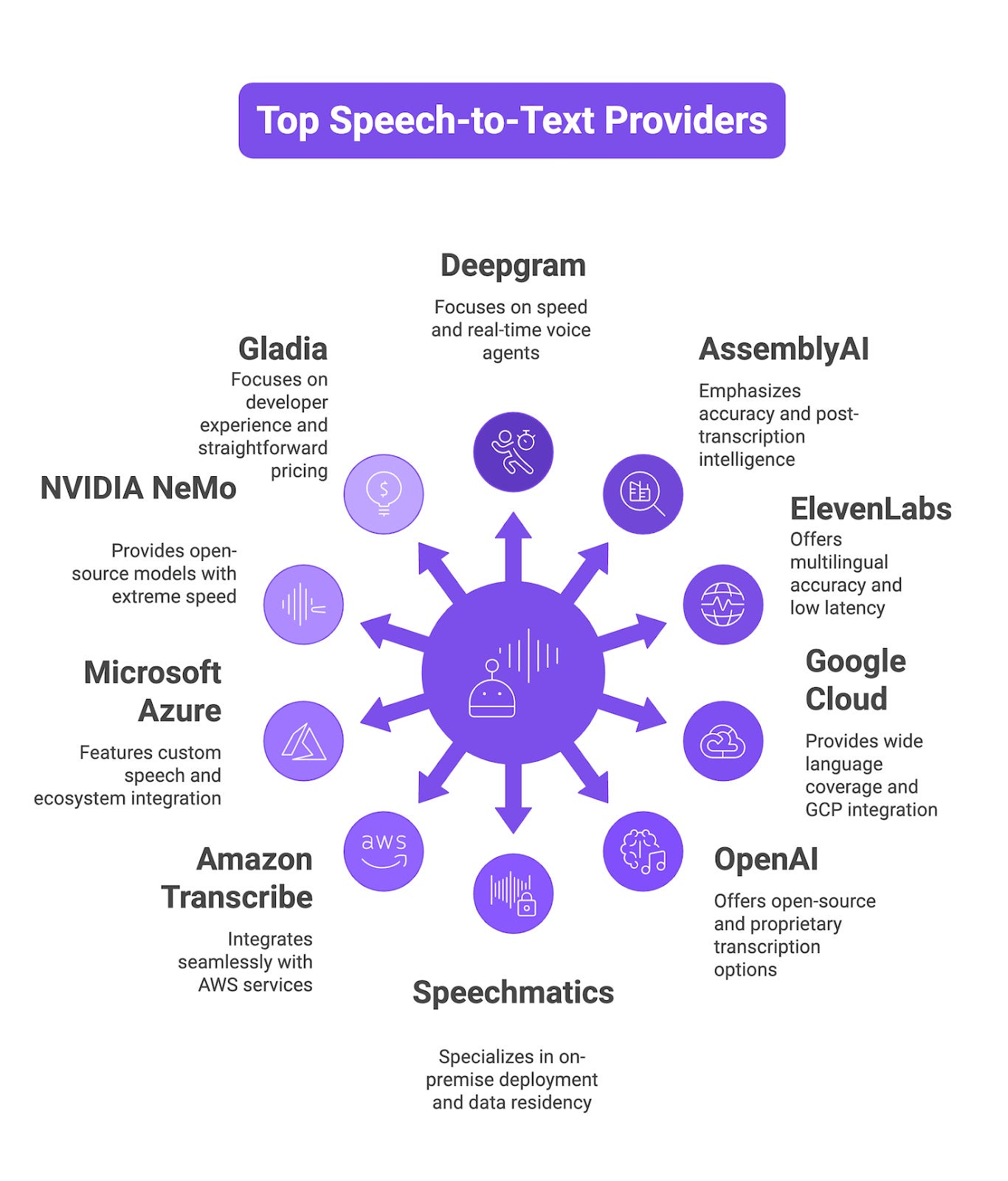
Deepgram builds speech recognition models from scratch, purpose-built for speed. Nova-3 cut word error rate by 54% against the closest competitor when tested on Deepgram’s own benchmark set covering nine audio domains. The Flux model is a separate product entirely, built specifically to detect when a speaker stops talking as fast as possible exactly what voice agent pipelines need.
Nova-3 delivers 5.26% WER in batch and 6.84% WER in streaming across real-world datasets spanning medical, finance, and call center audio. Flux handles real-time multilingual transcription across 36+ languages and manages code-switching when speakers jump between languages mid-sentence. The platform includes WebSocket streaming, keyterm prompting, speaker diarization, and real-time PII redaction for up to 50 entity types.
Best for: Real-time voice agents, conversational AI, and high-volume streaming where latency is the top priority.
Pricing: $0.0043/min batch, $0.0077/min streaming (pay-as-you-go). Growth plan from $0.0036/min batch. $200 in free credits to start.
2. AssemblyAI
AssemblyAI focuses on accuracy and post-transcription intelligence. Their Universal-2 model hits around 14.5% WER on challenging mixed datasets and includes built-in speech intelligence features like sentiment analysis and PII detection. They also released Slam-1, a speech-language model, in late 2025.
Universal-2 produces 30% fewer hallucinations than Whisper Large-v3. Beyond raw transcription, AssemblyAI bundles sentiment analysis, topic detection, entity recognition, and content moderation directly into the pipeline. Slam-1 goes further by actually understanding what is happening in the audio, not just converting it to text. The platform covers 99+ languages total, with live multilingual streaming currently working across six of them.
Best for: Workflows that need more than a raw transcript meeting analytics with automatic sentiment and topic extraction, compliance workflows that flag specific language, or media pipelines that need structured data from audio.
Pricing: Starts around $0.37/hour, with volume discounts at higher commitments.
3. ElevenLabs (Scribe v2)
ElevenLabs entered the STT space in early 2025 with Scribe v1, then quickly followed with Scribe v2 and a Realtime variant. On the FLEURS benchmark, Scribe v2 Realtime hits 93.5% accuracy across 30 languages while keeping latency under 150ms. That combination of speed and multilingual accuracy is hard to find elsewhere.
The Realtime model uses predictive next-word transcription across 90+ languages. It supports up to 32-speaker diarization, audio event tagging (laughter, applause), keyterm prompting, automatic language detection, and mid-conversation language switching. On the compliance side, it covers SOC 2, HIPAA, and GDPR, with EU data residency available.
Best for: Teams already using ElevenLabs for text-to-speech who want one vendor for both sides of the voice pipeline, and any product where multilingual accuracy is a hard requirement.
Pricing: Scribe v1 and v2 run between $0.22/hour (enterprise) and $0.40/hour (smaller tiers). The Realtime version sits between $0.39/hour and $0.48/hour depending on plan.
4. Google Cloud Speech-to-Text
Google offers the widest language coverage in the STT market — 125+ languages across models like Chirp 2, Chirp 3, and specialized variants for medical and phone call audio. That breadth makes it a natural default for multilingual products, though independent benchmarks show it often trails specialized providers in real-time accuracy.
Google provides specialized models tuned for medical audio, phone calls, and separate variants for short and long recordings. There is a built-in accuracy evaluation tool in the console that lets you upload your own audio with ground-truth transcripts and get WER numbers without writing code. Everything plugs directly into the rest of GCP, including Vertex AI.
Best for: Multilingual products, teams whose infrastructure already lives on GCP, and organizations with deep investment in the Google Cloud ecosystem.
Pricing: $16.00 per 1,000 minutes at the standard rate. Drops to $4.00 per 1,000 minutes above 2 million minutes a month.
5. OpenAI (Whisper & GPT-4o Transcribe)
OpenAI offers two paths. You can self-host the open-source Whisper models on your own infrastructure, or call the proprietary GPT-4o Transcribe API. GPT-4o Transcribe has posted strong benchmark numbers, achieving approximately 8.9% WER on Artificial Analysis benchmarks, with the lowest WER in a few independent tests. The tradeoff is price it costs noticeably more than most alternatives.
Whisper Large-v3 remains a solid open-source option with strong multilingual performance across 57+ languages. Both options handle noise and accents well. Whisper is also available through third-party inference providers like Groq, Fireworks, and Replicate for faster or cheaper processing.
Best for: Batch transcription, self-hosted setups where you want full model control, or any situation where accuracy matters more than speed.
Pricing: GPT-4o Transcribe costs $6.00 per 1,000 minutes. Whisper via third-party hosts varies from $0.50 to $3.00 per 1,000 minutes depending on the provider.
6. Speechmatics
Speechmatics has been in the enterprise STT space for years, and their standout feature is on-premise deployment for teams whose data cannot leave their own servers. The Enhanced model maximizes accuracy; the Default model trades some accuracy for faster processing. They recently added their own TTS product, so you can now run both sides of the voice pipeline through a single vendor.
The platform supports 55+ languages with strong accent and dialect handling, real-time streaming with word-level timestamps, and built-in speaker diarization. Enterprise compliance certifications and data residency controls round out the offering for regulated industries.
Best for: Enterprise teams with strict data residency rules, regulated sectors like finance and healthcare, and anyone who needs STT running entirely on their own infrastructure.
Pricing: No public price list. Requires a conversation with sales for a volume quote.
7. Amazon Transcribe
If your stack already runs on AWS, Amazon Transcribe is the path of least resistance. It handles 100+ languages, offers automatic language identification, and hooks directly into S3, Lambda, and Amazon Connect without extra glue code.
The platform includes specialized models for medical transcription (HIPAA eligible) and a Call Analytics model for contact center use cases. Custom vocabulary and custom language model support are available for domain-specific needs.
Best for: AWS-native architectures, call center analytics via Amazon Connect, and healthcare applications needing HIPAA-eligible transcription.
Pricing: $0.024/min for both streaming and batch, with volume discounts at higher tiers.
8. Microsoft Azure Speech
Azure Speech Services stands out with its Custom Speech capability, which lets you fine-tune recognition models on your own audio and text data. This is a significant advantage for domain-specific deployments where standard models struggle with specialized vocabulary.
The platform supports real-time and batch transcription across 100+ languages, integrates deeply with the Microsoft ecosystem (Teams, Dynamics, Power Platform), and offers on-device deployment via the Speech SDK for edge scenarios.
Best for: Enterprise Microsoft shops, products needing custom-trained models on proprietary vocabulary, and edge or on-device deployments.
Pricing: $1.00/hour standard, $1.40/hour for custom models. Free tier includes 5 hours per month.
9. NVIDIA NeMo (Canary / Parakeet- Open Source)
NVIDIA’s open-source ASR models currently sit at the top of the Hugging Face Open ASR Leaderboard. Canary Qwen 2.5B holds the number one spot with 5.63% WER, pairing a FastConformer encoder with a Qwen3-1.7B LLM decoder. On the speed side, the Parakeet TDT models process audio at close to 2,000x real-time, making them the fastest open-source option available by a wide margin.
Canary Qwen operates in a dual mode that combines transcription with LLM analysis. The models are trained on over 65,000 hours of diverse audio data. Parakeet TDT ships under an Apache 2.0 license; Canary uses a custom license. Both require the NVIDIA NeMo toolkit.
Best for: Teams with GPU infrastructure who want full control, self-hosted batch processing at scale, and research or prototyping on cutting-edge architectures.
Pricing: Free and open source. You pay only for GPU infrastructure.
10. Gladia (Solaria-1)
Gladia has earned a spot on the Artificial Analysis leaderboard alongside major providers with their Solaria-1 model. They position themselves as an STT-first API company with a focus on developer experience and straightforward pricing.
The platform offers real-time and batch transcription with speaker diarization, a clean REST API with solid documentation, and audio intelligence features including summarization and sentiment analysis.
Best for: Startups and mid-size teams looking for a focused STT API with good developer ergonomics and competitive pricing.
Pricing: Usage-based. Check gladia.io for current rates.
Recommendations by Use Case
Voice agents (real-time): Deepgram Flux and ElevenLabs Scribe v2 Realtime offer the lowest end-of-speech latency and the WebSocket streaming support that real-time pipelines demand.
Call center analytics: AssemblyAI and Amazon Transcribe come with built-in intelligence and compliance features that contact center workflows require out of the box.
Multilingual products: Google Cloud and ElevenLabs Scribe deliver the broadest and deepest language coverage respectively.
Self-hosted and on-premise: NVIDIA NeMo, Whisper, and Speechmatics give you full data control with no vendor lock-in.
Medical transcription: Deepgram Nova-3 Medical and Azure Custom Speech provide domain-specific models with HIPAA compliance.
High-volume batch: Deepgram in batch mode and OpenAI Whisper (via third-party hosts) offer the best price-performance at scale.
How to Choose: A Practical Decision Framework
Picking an STT provider is not about chasing the best benchmarks. It is about matching the right provider to your constraints. Walk through these four steps before committing.
Step 1: Define your latency requirements
Start with a simple question does your app need real-time streaming, or is batch processing sufficient? If you are building a voice agent or live captioning system, streaming is non-negotiable. You need WebSocket support that delivers the first partial transcript in under 300ms. If you are transcribing recorded calls or podcast episodes after the fact, batch mode costs less and usually produces better accuracy.
Step 2: Test with your own audio
Never trust vendor benchmarks alone. Collect 50–100 representative audio samples from your production environment. Include edge cases noisy backgrounds, accented speakers, domain-specific terminology. Run them through two or three providers and compare WER, latency, and formatting quality side by side.
Step 3: Calculate the real cost
Do not just look at the per-minute rate. Account for diarization fees, redaction add-ons, infrastructure costs if you are self-hosting, and how many engineering hours it takes to wire everything up. A slightly more expensive API with solid SDKs and clear documentation can save your team weeks of work compared to a cheaper option with rough tooling.
Step 4: Build for multi-provider failover
Production voice systems should never depend on a single STT provider. Architect your system to support switching. Route a percentage of traffic to an alternative, monitor accuracy and latency continuously, and maintain a failover path if your primary provider degrades. This is where observability becomes critical.
Keeping STT Working in Production
Choosing a provider is step one. Keeping it working well in production is the harder problem. Models update without warning. Latency spikes during peak hours. Accuracy drifts on certain accent groups. Vendor dashboards rarely surface these issues.
Future AGI is an evaluation, simulation, and observability platform built for this challenge. It lets you A/B test STT providers side by side on the same audio, measuring transcription accuracy, latency, and tone quality in a controlled environment. Unlike most testing tools that only look at transcripts, it evaluates actual audio output catching latency spikes, tone mismatches, and quality drops that text-based analysis misses.
On the observability side, TraceAI (open-source, built on OpenTelemetry) instruments your voice agent and delivers real-time metrics on STT performance. It detects P95 latency regressions, WER drift, and provider-level anomalies before your users notice. You can also run thousands of synthetic conversations with diverse accents, noise profiles, and edge-case scenarios before a single real user touches your system.
As STT providers update their models, Future AGI automatically reruns your evaluation suite and flags degradation. It does not replace your STT provider it makes sure whichever provider you choose keeps performing the way you expect, every day, at scale.
Conclusion
The STT market in 2026 is more competitive than it has ever been. Deepgram leads on latency and cost-efficiency. ElevenLabs Scribe v2 delivers strong multilingual accuracy. AssemblyAI bundles rich transcript intelligence. Open-source models from NVIDIA are closing the accuracy gap fast. The hyperscalers Google, AWS, Azure remain solid choices for teams already embedded in their ecosystems.
But here is the thing most comparison articles skip: your production performance will not match any benchmark. Your audio is unique. Your users are unique. The only way to find the right provider is to test with your own data, monitor continuously, and build the infrastructure to switch when things change. Start with two or three providers, run controlled tests, and let real data drive your decision.
FAQ
How does speech-to-text technology convert audio to written words? Speech-to-text (also called automatic speech recognition) uses deep learning models trained on millions of hours of audio to turn spoken language into text. Cloud-based STT APIs like Deepgram, AssemblyAI, and ElevenLabs process your audio on their servers and return transcripts through REST or WebSocket connections.
Which STT API delivers the lowest word error rate in 2026? For clean English audio, NVIDIA Canary Qwen (5.63% WER) and Deepgram Nova-3 (5.26% WER in batch mode) currently lead independent ASR leaderboards. Benchmark numbers rarely match real-world production audio, so always test with your own recordings before committing.
What is the best real-time STT API for building voice agents? Deepgram Flux and ElevenLabs Scribe v2 Realtime are the two strongest options for low-latency streaming. Scribe v2 RT achieves transcription latency under 150ms over WebSocket. Both support partial results and fast end-of-speech detection, which is critical when your full round-trip through STT, LLM, and TTS needs to stay under 800ms.
How much does cloud speech-to-text cost per audio hour in 2026? Deepgram is the most affordable cloud option at roughly $0.26/hour for batch and $0.46/hour for streaming. Google Cloud runs about $0.96/hour and AWS Transcribe lands near $1.44/hour. Open-source models like Whisper and NVIDIA NeMo are free, though you need your own GPU infrastructure.
What is the difference between STT, ASR, and voice recognition? Speech-to-text produces formatted, readable transcripts with punctuation and speaker labels. Automatic speech recognition outputs raw, unformatted text intended for machine processing. Voice recognition is an entirely different technology it identifies who is speaking through biometric analysis rather than transcribing what they say.
What streaming latency should I target for conversational AI? For voice-to-voice interactions, your total round-trip (STT + LLM + TTS) should stay under 800ms. That gives your STT layer a budget of roughly 150–300ms. Anything above 500ms makes conversations feel noticeably sluggish. Prioritize providers with strong WebSocket streaming support and fast time-to-first-partial metrics.
How do I test and compare STT providers for my use case? Collect 50–100 audio samples from your actual production environment, including noisy recordings, speakers with different accents, and clips with domain-specific vocabulary. Run them through two or three providers using their free tiers and compare results. For ongoing monitoring after you have chosen a provider, platforms like Future AGI Simulate let you A/B test on the same audio and catch accuracy or latency regressions before they reach real users.