
Future AGI Voice AI Simulation vs Competitors
Discover how Future AGI Simulate compares to Cekura, Hamming, Bluejay & Coval for voice AI testing with automated scenarios and direct audio evaluation.

Introduction
Voice AI agents look simple — ask a question, get an answer. Behind this lies complex technology handling real-world unpredictability. Manual testing and basic scripts miss critical production issues:
Latency: Millisecond delays break conversation flow
Interruptions: Non-linear conversations with backtracking and topic changes
Complex Flows: Unexpected questions and context switches
Accent Bias: Recognition failures with non-native speakers and regional accents
Background Noise: Traffic, offices, and poor connections cause transcription errors
Emotional Tone: Missing sarcasm, frustration, or urgency
This analysis compares five voice AI testing platforms: Future AGI, Cekura, Hamming, Bluejay, and Coval.
Tool 1: Future AGI Simulate
Future AGI Simulate automates voice AI testing through AI-powered test agents that simulate realistic conversations. The platform generates scenarios from customer datasets, conversation graphs, edge case scripts, or auto-generated scenarios based on agent capabilities.

Tests run through your actual voice infrastructure and evaluate audio directly, catching latency, tone, and flow issues that text-based testing misses. Some of the key technical features are:
Direct Audio Evaluation
Analyzes actual audio output, revealing latency spikes, tone inconsistencies, and quality degradation invisible in text logs. Works with any voice provider or telephony setup.
Automated Scenario Generation
Datasets: Customer profiles and behaviors
Graph: Conversation flows with branching logic
Script: Specific edge cases
Agent-Generated: AI-created scenarios based on capabilities
Multilingual & Multi-Persona
Tests across 50+ languages with diverse personas featuring different accents, speaking speeds, and behaviors.
No-Code Integration
Connect via phone number or API endpoint — no SDK, webhooks, or custom code required.
Comprehensive Platform
Integrates evaluation, observability, prompt optimization, guardrails, and tracing. Test results feed into optimization workflows automatically.
Tool 2: Cekura
Cekura provides testing and observability for conversational AI, helping teams validate agents before launch through simulations and production monitoring.
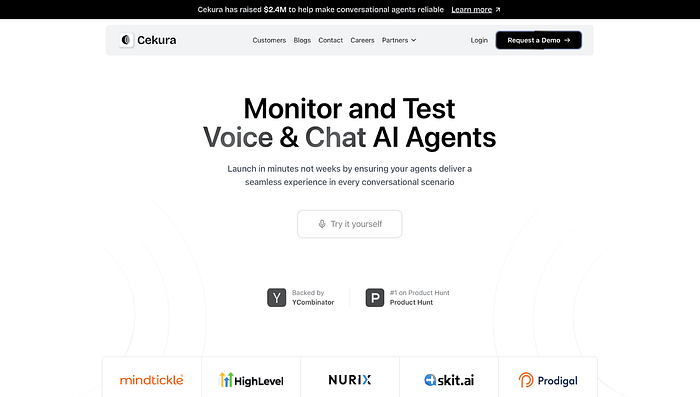
Image 1: Cekura — Source
Cekura vs. Simulate
Cekura validates predefined workflows with manually configured persona-based scenarios. It checks compliance and excels at testing known conversation paths.
Key Differences:
Testing: Manual workflows vs. auto-generated diverse scenarios
Audio: Transcript evaluation vs. direct audio analysis
Creation: Manual test cases vs. automatic generation
Scope: Voice agent specialist vs. full LLM platform
Strengths:
Strong call replay for diagnosing production issues
Fast deployment for known workflows
Real-time alerting for metric failures
Native Webex AI integration
Custom evaluation metrics
Limitations:
Relies on predefined personas, may miss edge cases
Transcript analysis overlooks audio-specific problems
Manual scenario configuration required
No integrated optimization tools
Tool 3: Hamming
Hamming automates testing and analytics for voice AI, simulating thousands of concurrent calls to identify bugs before production.
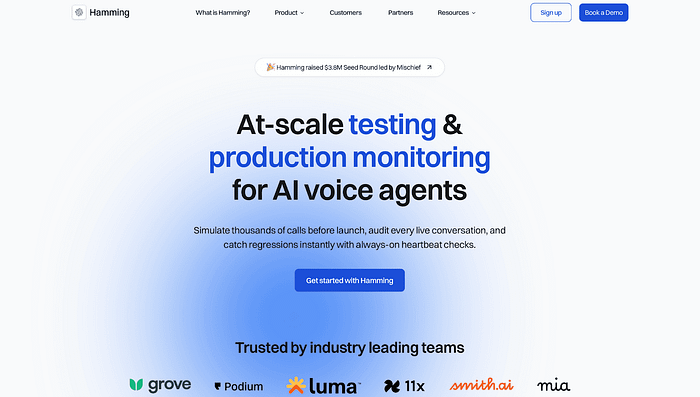
Image 2: Hamming — Source
Hamming vs. Future AGI Simulate
Hamming runs thousands of concurrent calls with AI-generated voice characters simulating interruptions, background noise, and accent variations. It converts production failures into new test cases automatically.
Key Differences:
Scale: Concurrent call testing vs. diverse auto-generated conversations
Audio: Transcript analysis vs. direct audio evaluation
Generation: Reactive production failures vs. proactive scenario creation
Scope: Testing and prompt management vs. full LLM observability
Strengths:
Massive scale testing (thousands of concurrent calls)
Production-to-testing feedback loop
AI voice character library with realistic behaviors
Built-in prompt versioning
Multilingual support (English, French, German, Hindi, Spanish, Italian)
Limitations:
No integrated optimization tools
Transcript-based analysis may miss audio quality issues
Pricing not readily available
Requires initial setup effort
Tool 4: Bluejay
Bluejay runs end-to-end tests through “human simulation,” creating synthetic customers with different languages, accents, and background sounds.
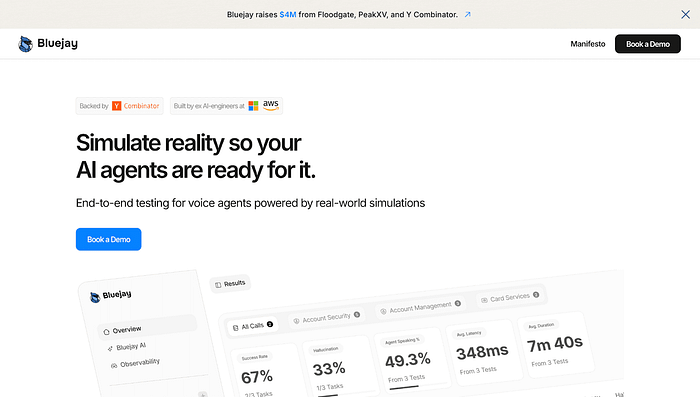
Image 3: Bluejay — Source
Bluejay vs. Future AGI Simulate
Bluejay creates synthetic digital customers with 500+ variables including languages, accents, emotional states, background noise, and conversation patterns. Compresses a month of interactions into minutes of stress testing.
Key Differences:
Simulation: Digital humans with 500+ variables vs. multi-persona test agents
Audio: Transcript metrics vs. direct audio output analysis
Focus: Stress testing through volume vs. scenario diversity
Monitoring: Skywatch real-time monitoring vs. full LLM observability
Strengths:
Ultra-realistic simulation with 500+ variables
Simulates a month of interactions in 5 minutes
Skywatch monitoring with detailed logs and fix suggestions
Automated updates to Slack/Microsoft Teams
Limitations:
No integrated optimization tools
Pricing not publicly available (enterprise-focused)
Requires setup for specific customer profiles
Limited public documentation
Tool 5: Coval
Coval applies autonomous vehicle testing principles (from over 10 years of Waymo experience) to conversational AI simulation and evaluation.
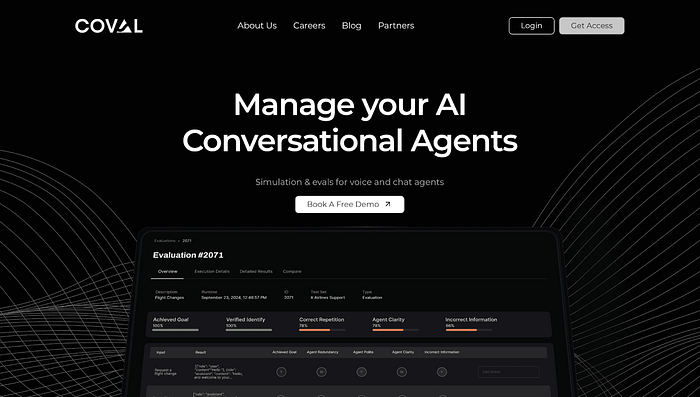
Image 4: Coval — Source
Coval vs. Future AGI Simulate
Coval generates thousands of test scenarios from prompts, transcripts, workflows, or audio inputs. Excels at CI/CD integration, automatically detecting regressions with every code change.
Key Differences:
Foundation: Autonomous vehicle methodology vs. AI agent-driven generation
Input: Defined prompts/transcripts/workflows vs. auto-generated scenarios
Audio: Custom voice metrics vs. direct audio evaluation
Scope: Testing and CI/CD regression vs. full LLM observability
Integration: CI/CD pipelines vs. no-code phone setup
Strengths:
Autonomous testing heritage from 10+ years of self-driving car testing
Comprehensive CI/CD integration with automated evaluations
Custom metrics framework for business-specific KPIs
Production monitoring with real-time alerts
Ideal for regulated industries (healthcare, finance, telecom)
Limitations:
Relies on provided inputs rather than auto-generating scenarios
No built-in optimization tools
Doesn’t include agent runtime or voice stack
Learning curve for custom metrics and CI/CD setup
Conclusion
Each platform offers distinct technical approaches to voice AI testing:
Future AGI Simulate: Comprehensive testing with direct audio evaluation, automated scenario generation, and integrated LLM observability. Best for end-to-end AI lifecycle management with no-code integration and multilingual testing (50+ languages).
Cekura: Specialized replay capabilities for diagnosing recurring production issues through actual call analysis. Strong for Webex AI infrastructure.
Hamming: High-volume concurrent testing with prompt version control and strong CI/CD integration. Ideal for teams prioritizing rapid iteration.
Bluejay: Stress-testing with 500+ behavioral variables using “human simulation.” Best for exhaustive pre-release testing.
Coval: Autonomous vehicle testing methodologies applied to conversational AI. Strong CI/CD integration with custom business metrics for regulated industries.
FAQs
What is Future AGI Simulate?
Future AGI Simulate is an automated testing platform that uses smart AI agents to mimic real-world voice and chat interactions, helping you spot issues and aim for 99% accuracy in your AI systems.
How does Cekura compare to other platforms like Future AGI Simulate?
Cekura focuses on strong production monitoring and replaying real customer calls for quick fixes, while Future AGI Simulate offers broader automated scenario generation and direct audio evaluation for more comprehensive testing.
What is the primary benefit of a voice AI simulation platform?
A simulation platform allows you to automatically test your voice agents against thousands of scenarios to identify issues and ensure reliability before they interact with customers.
Can Future AGI help improve my AI agent’s accuracy?
Yes, Future AGI is an end-to-end platform for LLM observability, evaluation, and optimization, designed to help you achieve up to 99% accuracy in your AI applications.
Most discussions here circle around tools, roles, and trends.
But the only real differentiator in the coming decade will be epistemic orientation — the ability to hold a coherent inner direction when everything else accelerates into noise.
People who can do that form a very small group.
They think at the level of architecture, not tactics.
They generate structure, not commentary.
If you recognise that in yourself — or feel you’re growing into it — you’re already part of the work I’ve been building.
My Substack Epistemic Futures is not a newsletter.
It’s the written-first infrastructure for people who want to operate from subject-autonomy rather than system-dependence.
If that is the layer you want to grow into, consider joining as a Founding Member:
👉 https://leontsvasmansapiognosis.substack.com
— Leon Tsvasman