
Closing the Loop: Coding Agents, Telemetry, and the Path to Self-Improving Software
Coding agents need telemetry and tracing to close the feedback loop, and this guide shows how instrumentation, evaluation, and observability drive full autonomy in 2026.

Coding agents are rewriting how software gets built. Tools like Claude Code, Codex, and Cursor now handle everything from writing functions to debugging entire codebases, often with minimal human input. A recent study of GitHub repositories found that 16 to 23 percent of code contributions already involve AI coding agents. That number is climbing fast.
But here is the problem: these coding agents can write code, yet they cannot verify whether that code works correctly in production. They lack runtime context. Without telemetry, a coding agent is working blind. It writes, ships, and hopes for the best.
This gap between code generation and verification is where telemetry changes everything. When coding agents get access to traces, metrics, and evaluation data, they stop guessing and start reasoning with evidence. The feedback loop closes, and that is the first real step toward full autonomy. This article breaks down how instrumentation, tracing, and observability create self-improving software when paired with coding agents.
Why Coding Agents Need More Than a Language Model
A coding agent is not just an LLM with a text editor. What makes these systems work is the harness: the surrounding infrastructure that manages context, orchestrates tool calls, handles permissions, and provides feedback mechanisms. Anthropic’s engineering team has documented this extensively, showing that even a frontier model running without structure fails at production-quality code.
The harness breaks tasks into smaller steps, persists progress, and provides checkpoints for verification. Two things follow from this. First, coding agents need the same tooling human developers rely on: documentation, debugging tools, and runtime data. Second, they need best practices baked into their workflow. Tracing and evaluation should be available from the start. This is where telemetry for AI agents becomes the critical infrastructure layer.
Traces Are the New Documentation for Agent-Built Software
In traditional software, you read source code to understand what an application does. The logic is deterministic and inspectable. Agent-driven applications work differently. The code defines which model to call and what prompt to send. The actual decision-making happens inside the model at runtime.
Traces capture how an agent behaves in practice: how many times it loops, which tools it invokes, where failures occur, and how prompt changes affect downstream behavior. Every operation developers performed on code, such as debugging and testing, must now be performed on traces.
For coding agents, the implications are direct. A coding agent without access to traces is an agent working without documentation. It will guess where failures happen, propose fixes based on incomplete information, and create the review overhead that automation was supposed to eliminate. A coding agent that can query traces sees what actually happened at runtime. It can identify reasoning errors, detect tool call loops, and validate that its changes produce measurable improvements.
The Feedback Loop: How Telemetry Enables Self-Improvement
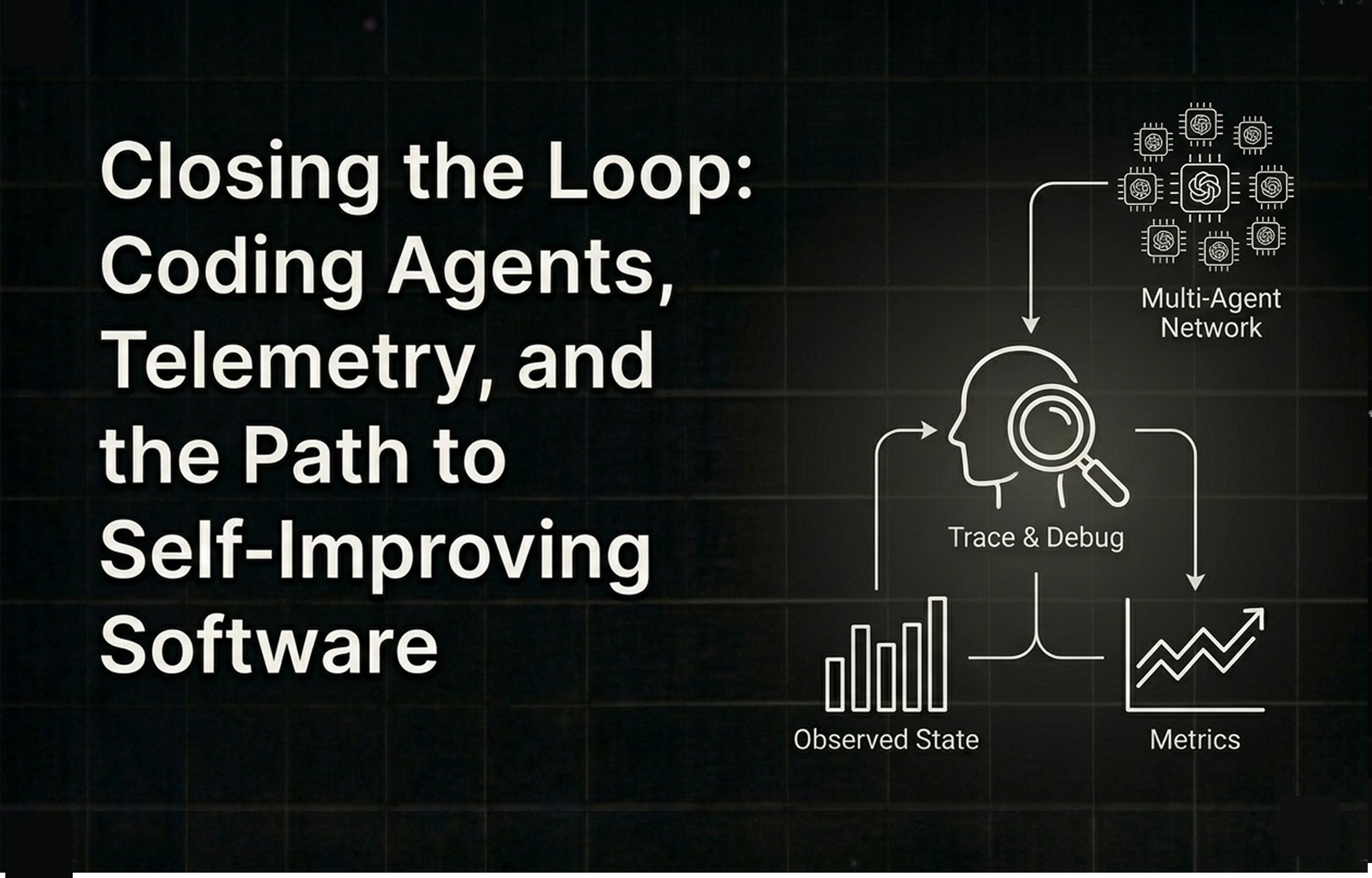
The idea behind self-improving software is straightforward. A coding agent receives a task, instruments the code paths, makes changes, and collects runtime telemetry. It queries traces to verify behavior and check quality. If needed, it iterates using trace data and evaluation feedback. Finally, it submits the change with supporting evidence: traces, evaluation scores, and reasoning.
This feedback loop is only possible because telemetry serves as ground truth for what the system actually does. Without it, there is no source of truth. Without evaluation on real traces, there is no empirical basis for claiming a change is an improvement. The whole loop collapses into guesswork.
OpenAI recently documented a project where Codex agents wrote approximately one million lines of code across 1,500 pull requests with zero manually written code. The key finding was about environment design, not model capability. When something failed, engineers asked: what capability is missing, and how do we make it visible to the agent?
Traditional Development vs. Agent-Driven Development
The shift from traditional development to agent-driven development affects every dimension of how software gets built.
The shift from traditional to agent-driven development affects every dimension. Source code gives way to traces and runtime telemetry as the source of truth. Debugging moves from code review and breakpoints to trace queries and span analysis. Verification shifts from unit and integration tests to evaluation on real traces. Feedback speed compresses from minutes/hours in CI pipelines to seconds/minutes via telemetry queries. Decision logic moves from deterministic and inspectable to probabilistic and runtime-dependent. And the primary observability consumer shifts from human engineers using dashboards to agents using APIs and CLI tools.
Practical Instrumentation with OpenTelemetry
OpenTelemetry has become the industry standard for collecting distributed traces, metrics, and logs. Its GenAI semantic conventions define a standardized schema for tracking prompts, model responses, token usage, and tool calls.
For AI agent workflows, instrumentation typically covers three layers. The first is LLM calls: capture model name, input tokens, output tokens, latency, temperature, and finish reason for every inference request. The second is tool execution: track every tool call the agent makes, including file reads, API calls, and database queries, recording inputs, outputs, and execution time. The third is agent orchestration: instrument the outer loop governing agent behavior, including task decomposition, retries, and decision points.
Libraries like OpenLLMetry and framework-specific packages for LangChain, CrewAI, and PydanticAI provide auto-instrumentation with minimal code changes. Install the package, configure an OTLP exporter pointing to your backend (Jaeger, Grafana Tempo, or a platform like Future AGI), and initialize the tracer provider at startup. Every agent action then generates structured spans that connect into a complete trace tree.
From Dashboards to Programmatic Interfaces
Here is where most observability setups fall short. Traditional platforms were built for humans: dashboards, heatmaps, and interactive query builders assume a person is at the screen. Coding agents do not benefit from charts. They need structured data returned through APIs and CLI tools, data they can parse and reason over within their execution context.
Dashboards remain useful for human audit. But the primary integration point shifts. Platforms that ship programmatic access patterns map naturally onto how coding agents operate. When an agent can query traces via a structured API call, prompts like “ensure startup completes in under 800 milliseconds” become tractable. The agent verifies its own work against runtime evidence.
Evaluation as the Quality Gate
Telemetry alone is not enough. You also need evaluation to determine whether agent outputs meet quality standards. Evaluation functions score agent behavior against specific criteria: accuracy, latency, safety, or any custom metric relevant to your application.
The practical workflow looks like this. First, capture traces during agent execution using OpenTelemetry instrumentation. Second, run evaluation functions against those traces, scoring prompt quality, tool selection accuracy, and output correctness. Third, feed evaluation results back into the agent’s context so it can self-correct. Fourth, set quality thresholds: if evaluations fail, the agent iterates; if they pass, the change ships.
Future AGI closes this loop by combining observability with automated evaluation. The platform captures traces via OpenTelemetry, runs evaluation metrics on real production data, and provides actionable feedback that can drive prompt optimization and agent improvement. The evaluation layer is what turns raw telemetry into a self-improvement signal.
Teaching Agents How to Use Telemetry
Access to tools is necessary but not sufficient. A coding agent with access to a tracing platform but no knowledge of how to use it effectively will produce noisy queries and draw poor conclusions.
Skills are focused, composable units of methodology that encode not just which tools to use, but when and how. A skill might define the query pattern for diagnosing a latency regression, the steps for correlating a prompt change with a behavioral shift, or the evaluation criteria for a specific task. OpenAI’s harness engineering experience confirmed that large monolithic instruction files fail predictably. What works is treating knowledge as a structured system of record with pointers to deeper sources.
Key Telemetry Signals for Coding Agent Workflows
Five telemetry signals matter for coding agents. Traces capture end-to-end request flow across spans using OpenTelemetryand Jaeger. Metrics track token count, latency, error rate, and cost via OpenTelemetry and Prometheus. Logs capture prompt content and tool inputs/outputs for debugging individual decisions. Evaluations produce quality scores on agent outputs using Future AGI or custom evals. Events capture model parameters, finish reasons, and errors using OTel GenAI Semantic Conventions.
What Full Autonomy Actually Looks Like
As coding agents approach full autonomy, the human role shifts from reviewing every line of code to auditing the self-verification mechanisms. Are traces captured correctly? Are evaluations meaningful? Are quality thresholds set appropriately?
The development cycle becomes a closed loop: the agent instruments code, runs changes, collects telemetry, queries traces, runs evaluations, iterates if needed, and submits a change with evidence. Andrej Karpathy described going from 80 percent manual coding to 80 percent agent-assisted coding in a single month at the end of 2025. Anthropic’s 2026 Agentic Coding Trends Report projects that agents will soon handle full application builds with periodic human checkpoints.
None of this works without the feedback loop. Without telemetry, agents operate blind. Without evaluation, there is no basis for trusting agent output. The organizations that invest early in observability and evaluation infrastructure will scale agent-driven development. Those that do not will face the review overhead that automation was supposed to remove.
Conclusion
Coding agents are already changing how software gets written. The question is whether they become reliable development partners or remain black-box code generators that create more review work than they save.
The answer depends on telemetry. Traces are the documentation layer for agent-built systems. Evaluation is the quality gate. Observability is what makes self-improvement possible. When coding agents get access to these signals through programmatic interfaces, the feedback loop closes.
The tooling exists. OpenTelemetry provides the instrumentation standard. Platforms like Future AGI provide evaluation and observability. The engineering patterns are documented. What remains is the decision to treat coding agents as full participants in the development process, equipped with the same tracing and verification mechanisms that reliable software has always required.
FAQs
1. What is telemetry for AI agents and why does it matter in 2026?
Telemetry for AI agents refers to the collection of traces, metrics, and logs from agent workflows at runtime. It matters because agent decisions happen inside models, not in source code. Without telemetry, you cannot debug, test, or verify agent behavior in production.
2. How do coding agents use traces to close the feedback loop?
Coding agents query traces to see what actually happened during execution. They identify tool call failures, reasoning errors, and latency issues. This trace data feeds back into the agent’s next iteration, creating a feedback loop that drives continuous self-improvement.
3. How does OpenTelemetry support instrumentation for coding agents?
OpenTelemetry provides standardized APIs and SDKs for capturing distributed traces and metrics. Its GenAI semantic conventions define how to track prompts, token usage, and tool calls. Auto-instrumentation libraries exist for LangChain, CrewAI, and other major frameworks.
4. What role does evaluation play in achieving full autonomy for coding agents?
Evaluation acts as the quality gate. It scores agent outputs against defined criteria using real trace data. Without evaluation, there is no way to confirm whether agent changes are actual improvements. It is the critical piece that separates autonomous agents from unsupervised ones.
5. How does Future AGI help with observability and evaluation for AI agents?
Future AGI provides an integrated platform that combines OpenTelemetry-based tracing with automated evaluation metrics. It captures agent traces in production, scores outputs for accuracy and quality, and provides actionable feedback that closes the improvement loop for coding agents.
6. Can coding agents achieve self-improvement without observability infrastructure?
No. Without observability, coding agents lack the runtime data needed to verify their own work. They cannot distinguish between successful and failed changes. Tracing and evaluation provide the ground truth that makes self-improvement possible instead of theoretical.