
AI Evaluation Platform ROI Analysis: Build vs Buy
Compare AI evaluation platform costs: Get ROI analysis, risk assessment & implementation guide for your team.

1. Introduction
Building quality GenAI products requires robust evaluation — there’s no shortcut. Yet while engineering teams spend weeks creating evaluation pipelines, custom scripts, and performance dashboards, they’re not working on what actually drives value: improving models and shipping features users need.
A basic in-house evaluation prototype costs $14,200-$28,100 initially (284 hours at $50-$99/hour). But that’s just the beginning. Infrastructure scaling, metrics updates, and edge case handling create ongoing budget drain. Developers get pulled from core model work to fix pipelines and resolve scoring inconsistencies, slowing release cycles.
This technical analysis breaks down real-world ROI calculations to help you determine when to build versus buy your evaluation platform.
2. Executive Summary
2.1 Total Cost of Ownership: 3-Year Analysis
Recent analysis by OpenLedger reveals stark financial differences:
Building in-house: $850,000-$1.65 million over three years (midpoint: $1.25 million). This includes $300K upfront development plus ~$200K annually for maintenance and compliance.
SaaS solutions: $87,000-$420,000 over three years. Even the high end costs 60–80% less than internal builds.
2.2 Time-to-Value Comparison
In-house development: 3–4 months of iterative development cycles requiring specialized expertise in ML evaluation frameworks, data pipeline architecture, and performance optimization.
Vendor platforms: 1–2 weeks to full deployment, enabling immediate model testing.
2.3 Team Productivity Impact
Offloading evaluation tooling returns approximately 40% more engineering time to model research and feature development. Ready-made dashboards, built-in collaboration, and automated reporting reduce context switching, keeping engineers focused on core work.
2.4 Risk Mitigation
SaaS systems provide service-level agreements, security certifications, and audit logs — helping achieve compliance without additional engineering overhead. Vendors handle scalability, version upgrades, and infrastructure health as data volumes increase.
3. True Cost of Building AI Evals In-House
3.1 Development Costs Breakdown
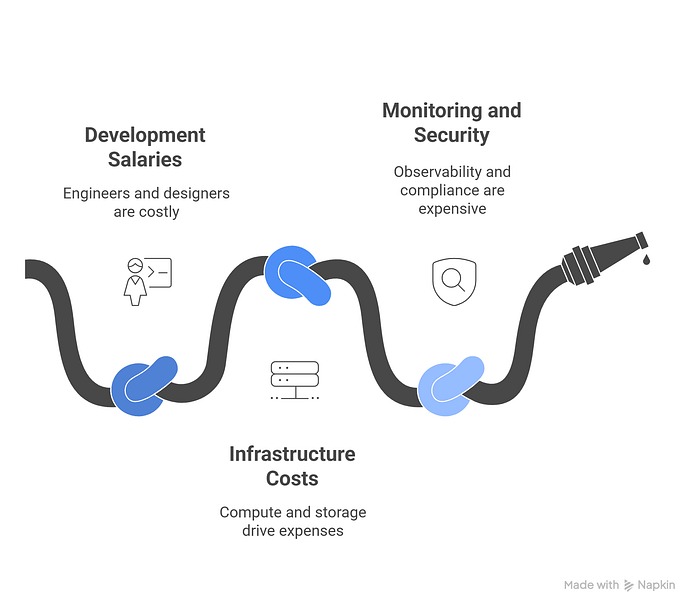
Salaries dominate AI evaluation development budgets:
Senior ML Engineer: $130,000-$200,000 base annually (average: $160,000)
DevOps Engineer: $125,000-$150,000 base annually
UI/UX Designer: $110,000-$125,000 base annually
3.2 Infrastructure Costs
Compute and GPUs: AWS p4d.24xlarge with 8 A100 GPUs costs $32.77/hour on-demand (~$23,900/month for 24x7 operation). A single training-grade GPU node creates five-figure monthly expenses.
Storage: S3 Standard pricing at $0.023/GB/month means 10TB costs ~$230/month and 50TB costs ~$1,150/month.
3.3 Monitoring and Security Tools
Observability: Datadog Infrastructure Monitoring starts at $15/host/month (Pro) to $23/host/month (Enterprise), with APM and logs billed separately.
Compliance: SOC 2 efforts including readiness, risk assessment, penetration testing, tooling, and formal audits typically cost $30,000-$50,000.
Penetration Testing: Market rates range from $5,000-$50,000+ per engagement depending on scope complexity.
4. Future AGI Platform: Investment and ROI Analysis
4.1 Future AGI Pricing Structure
Future AGI uses transparent pay-as-you-go pricing:
Free Plan: $0/month for up to 3 seats with core features and generous usage limits
Pro Plan: $50/month for up to 5 seats, includes alerting, dashboards, error localization, and eval feedback
Enterprise Plan: Custom pricing with volume discounts, SLAs, on-premises options, SSO, and compliance certifications
4.2 Implementation Timeline
Same-day deployment process:
Account setup and API key configuration (minutes)
SDK integration with OpenAI, Anthropic, or Hugging Face
End-to-end tracing enablement for cost, latency, and anomaly detection
Evaluator and guardrail activation for production endpoints
Dashboard, alert, and incident view activation
Total implementation cost: Minimal subscription fees ($0-$50/month) plus standard onboarding versus six months of full-time engineering salaries.
5. Three-Year TCO Comparison
5.1 In-House Solution TCO
Year 1:
Development: $70,500 (ML engineers, DevOps, UI/UX salaries)
Infrastructure: $36,000 (~$3,000/month for networking, storage, cloud servers)
Maintenance: $25,000 (20–30% of development budget for fixes and features)
Year 1 Total: $131,500
Years 2–3 (annually):
Ongoing Development: $40,000 (feature improvements)
Infrastructure Scaling: $60,000 (additional servers, autoscaling, backups)
Maintenance & Support: $35,000 (security patches, compliance audits)
Years 2–3 Total: $270,000
3-Year In-House Total: $401,500
5.2 Future AGI Platform TCO
Pro Plan: $50/month × 36 months = $1,800
Implementation: $0 (included onboarding, training, support)
3-Year Total: ~$1,800 base + variable usage (typically lower due to pay-as-you-go structure)
5.3 ROI Calculation
Total Savings: $401,500 — $1,800 = $399,700
ROI: 22,206% (reflecting low entry point and scalable costs)
Payback Period: <1 month ($11,153/month in-house vs. ~$50/month base)
Total implementation cost: Minimal—subscription fees start at $0–$50/month plus standard onboarding time, versus six months of full-time engineer salaries for in-house builds.
6. Build vs Buy Comparison
6.1 In-House Development Risks
Technical Risks: 70–85% of AI initiatives miss timelines or fail to meet objectives. Approximately 67% of custom infrastructure projects exceed original schedules.
Talent Risks: Most evaluation stacks rely on open-source frameworks (LangChain, Hugging Face, FastAPI). Losing ML or DevOps engineers mid-project can halt development for weeks. 89% of open-source projects lose core contributors, with 70% experiencing this within three years.
Scaling Risks: Over 40% of custom AI stacks require urgent re-engineering before achieving reliable production scale.
6.2 Future AGI Risk Mitigation
Proven Platform: Trusted by numerous AI teams across finance, healthcare, and e-commerce
Compliance Built-in: GDPR, SOC 2, and enterprise security standard
24/7 Support: Infrastructure monitoring and incident response
SLA Guarantees: 99.9% uptime assurance
7. Building Accurate Evaluation
7.1 The In-House Challenge
Time-Intensive Frameworks: Creating accurate evaluation frameworks from scratch requires months of defining metrics, writing scoring logic, and handling edge cases.
Generic Metrics Limitations: Simple pass/fail or keyword matching insufficient for modern AI models. Advanced measurements like semantic similarity, relevance, and factual correctness require sophisticated models and algorithms.
“Eval as a Product” Overhead: Reliable accuracy demands treating evaluation systems as dedicated products with roadmaps, constant updates, and maintenance teams — significant overhead that distracts from core business goals.
7.2 The Future AGI Advantage
Proprietary Evaluation Models: State-of-the-art models specifically trained for evaluation tasks, delivering best-in-class accuracy for measuring correctness, tone, and style nuances.
Pre-Built and Custom Evaluators: Access to evaluation libraries for common tasks (summarization, Q&A, sentiment analysis) plus custom evaluator creation using powerful underlying models.
Focus Optimization: Complete evaluation system burden offloading allows teams to focus on result interpretation and model improvement rather than debugging evaluation scripts.
8. Team Productivity and Efficiency Gains
8.1 Developer Productivity Metrics
Evaluation Setup: Reduced from two weeks to two hours for full testing pipeline deployment.
Model Testing Cycles: Accelerated from weekly to daily testing, enabling faster feedback on experiments.
Incident Response: Automated alerts and error localization reduce average AI problem resolution from hours to minutes.
Team Onboarding: New hire ramp-up reduced from four weeks to three days with guided tutorials and templates.
8.2 Quantified Productivity Benefits
Time Savings: ML engineers reclaim ~15 hours/week previously spent on setup, maintenance, and debugging
Iteration Speed: 3x faster model testing enables rapid idea-to-result confirmation
Context Switching Reduction: Engineers focus on model work instead of switching between dashboards, scripts, and deployment tasks
Value Per Engineer: ML engineers earning $75/hour can generate additional $58,500 annually from 15 hours/week time savings
9. Real-World Case Studies
9.1 Case Study: Mid-Size AI Startup
Challenge: AI startup building meeting summarization product stuck in six-month evaluation pipeline development loop. Product launch delayed twice with top engineers maintaining infrastructure instead of innovating.
Solution: Switched to Future AGI, achieving 48-hour implementation. Integrated SDK with existing prompt library, attached preset “summary” and “faithfulness” evaluators, and configured automated guardrails.
Results:
4 Months Ahead of Schedule: Eliminated evaluation bottleneck, beat competitors to market
$180,000 Engineering Cost Savings: Reallocated two senior engineers (six months) to core development
3x Faster Iteration: Testing cycles reduced from weekly to daily
9.2 Case Study: Enterprise AI Team
Challenge: Large enterprise AI division overwhelmed by complexity across 50+ language and vision models. Manual pipeline adjustments and expensive server upgrades created inconsistent metrics and frustrated data scientists.
Solution: Adopted Future AGI Enterprise Plan. Connected all model endpoints to unified observability layer using Model Context Protocol (MCP) within three weeks.
Results:
70% Infrastructure Cost Reduction: Replaced sprawling self-hosted servers with single SaaS plan
5x Faster Model Deployment: New models/updates released every two days vs. two weeks
Uptime Improvement: System reliability increased from 94% to 99.9% with SLA backing
Effortless Compliance: Built-in GDPR and SOC 2 features eliminated audit pressure
10. When to Build vs Buy
10.1 Build In-House When:
Unlimited Resources: Full team availability for 6–12 months without impacting core AI work
Evaluation as Competitive Advantage: Custom metrics or proprietary scoring represent primary differentiation
Strict Data Locality: Regulations require complete on-premises data retention with no vendor access
10.2 Choose Future AGI When:
Time-to-Market Critical: Two-week deployment vs. six-month custom builds
Engineering Focus on Core AI: Offload dashboards, alerts, maintenance so ML experts concentrate on modeling
Proven Scalable Infrastructure: Platform serves 100+ teams, scales to millions of requests, avoids re-architecture headaches
Enterprise Security/Compliance Required: Built-in GDPR, SOC 2, SSO eliminate audit delays
Note: Extremely unique evaluation requirements (rare edge cases) may necessitate custom solutions, but this applies to <10% of use cases.
Conclusion
The numbers speak clearly: Future AGI delivers $394,700 in savings over three years, reducing TCO from $401,500 to $6,800. You accelerate from six-month development delays to live pipelines in under two weeks.
Beyond cost savings, you gain 99.9% uptime backed by SLAs and battle-tested performance across 100+ teams, while in-house efforts carry 85% project failure risk. This reliability eliminates emergency fixes and compliance headaches.
Most importantly, your ML engineers reclaim ~15 hours weekly for core model work instead of infrastructure maintenance. Faster feedback loops and fewer incidents keep innovation central — not dashboard debugging.
Next Steps
Calculate Your ROI: Determine personalized savings and break-even point
Schedule ROI Consultation: Get guided cost analysis for your specific use case
These steps move you from uncertainty to impact: fast, secure, and budget-friendly.
FAQs
What are Future AGI’s pricing options?
Future AGI has a Free plan for up to three seats, a Pro plan that costs $50 per month (billed monthly with two months free on an annual basis) for up to five seats, and a custom-priced Enterprise plan.
How much can teams save over 3 years by using Future AGI instead of building in-house?
Companies can save about $399,700 (over 98%) by switching from in-house to Future AGI Pro and paying $50/month. Their 3-year TCO will go from about $401,500 to $1,800 base + usage‑based metering.
When should you buy rather than build an AI evaluation platform?
Buy, when you need to launch in weeks, keep your engineers focused on core ML work, and depend on proven scalability, security, and compliance, build only if you have the time, specialist talent, and a use case so unique that no commercial platform can satisfy it.
What ROI can teams expect with Future AGI compared to in-house builds?
Teams typically see an order-of-magnitude return and recuperate their investment within weeks because Future AGI removes the ongoing engineering, infrastructure, and compliance costs that make in-house evaluation stacks so expensive to run.