
Multimodal AI in 2026: What's Happening Now and What's Coming Next
Agentic AI, embodied robotics, and model distillation, the multimodal AI stack is production-ready. Here's what's actually shipping in 2026.

Multimodal AI is no longer experimental. In 2026, production systems routinely process text, images, video, and audio within a single model to solve problems that no single modality can address alone.
The applications make the case clearly. Autonomous vehicles must read road signs, detect pedestrians, and respond to sirens simultaneously. Diagnostic systems cross-reference patient records, X-rays, and clinical notes to surface patterns a radiologist reviewing one data type at a time would miss. These tasks demand joint comprehension of multiple data forms, and that is precisely where current multimodal systems outperform their unimodal predecessors.
How Multimodal Systems Actually Work
Earlier architectures processed each modality in isolation and combined the results at the end. Today’s leading models Llama 4 (Meta), GPT-5 (OpenAI), and Gemini 3 (Google DeepMind) do something fundamentally different. They run everything through a shared transformer backbone. Images are split into patch tokens, audio is converted to spectrograms or discrete tokens, and text remains as word tokens. All of it flows through the same network, which learns cross-modal relationships directly. This unified approach is both more efficient and more accurate than maintaining separate pipelines.
Core Technical Approaches
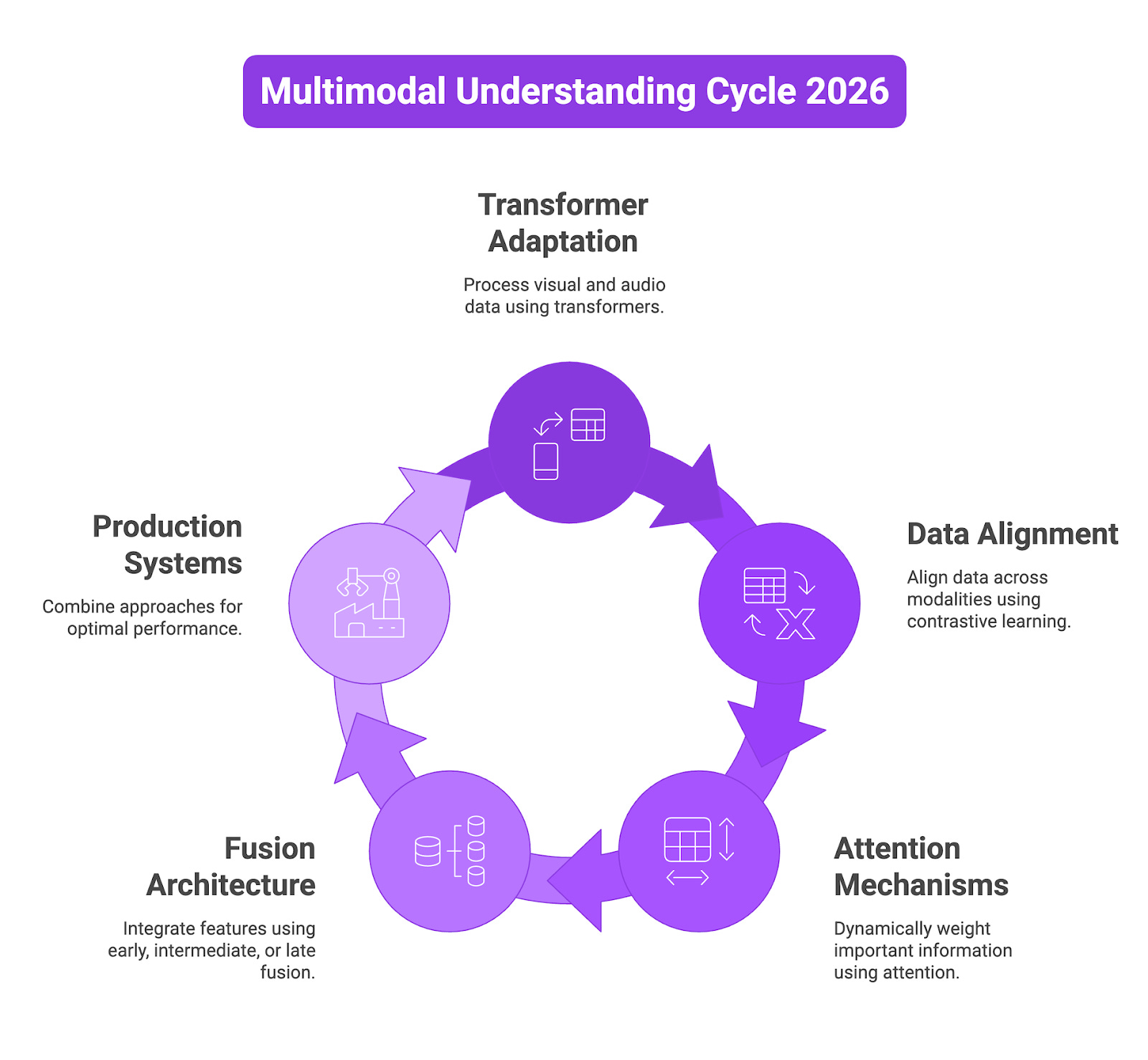
Transformer adaptation for visual and audio data. Vision Transformers (ViT) break images into patches and process them as token sequences, applying the same transformer logic originally designed for text. Audio Transformers do the same with spectrogram representations. Models like Llama 4 Scout and Maverick go further, using a mixture-of-experts (MoE) architecture that activates only the relevant expert subnetworks for a given task reducing compute without sacrificing performance.
Data alignment and joint representation. Processing separate modalities is the easier part. The harder problem is making them interact meaningfully. Two techniques dominate here:
Contrastive learning trains the model to place semantically related items a photo and its caption, for instance close together in embedding space, while pushing unrelated pairs apart. This teaches the model to find connections across modalities without explicit labels for every combination.
Cross-attention mechanisms decide dynamically what information matters. When a model processes a medical image alongside clinical notes, cross-attention layers can weight a specific word in the text to guide focus toward a particular region of the image. For video, temporal attention tracks how scenes change over time.
Fusion architecture choices. Production systems rarely use a single fusion strategy. Early fusion combines modalities at the input layer, which works well when inputs are tightly synchronized. Intermediate fusion processes each modality independently first, then merges features at a middle layer useful when inputs aren’t perfectly aligned. Late fusion keeps modalities separate until the final prediction, combining outputs through voting or weighting. This handles missing data gracefully but can miss cross-modal interactions. Most deployed systems mix all three: extract vision features early, fuse them with audio at an intermediate stage, then combine everything during final reasoning.
How Models Reason Across Modalities
Multimodal chain-of-thought reasoning decomposes complex problems by integrating visual, textual, and auditory evidence step by step. The model doesn’t just produce an answer it shows how it arrived there.
Consider a diagnostic scenario. A system receives a chest X-ray, a text transcript of the patient’s symptoms, and an audio recording of the physician’s notes. Instead of jumping to a conclusion, the model reasons sequentially: “The X-ray shows opacity in the lower left lobe. The transcript reports a persistent cough lasting three weeks and night sweats. The audio indicates the patient is 58 years old with a smoking history.” It then synthesizes these observations into a diagnosis. Models that reason this way consistently outperform those that process modalities independently.
For tasks with multiple valid interpretations ambiguous visual scenes, financial scenarios with competing signals some models add tree-of-thought reasoning, exploring several decision paths before selecting the strongest one.
The Leading Models of 2026
Llama 4 (Meta). The Scout and Maverick variants are open-weight models with native multimodal support. Their MoE architecture activates only the subnetworks relevant to each task, and an early fusion strategy integrates visual tokens directly into the model backbone. The result is faster inference and lower power consumption compared to older adapter-based approaches.
GPT-5 (OpenAI). GPT-5 generates video from text, interprets images, and writes code within a single system. Its real-time cross-modal reasoning evaluates video frames and generates context-aware responses fast enough for live applications.
Gemini 3 (Google DeepMind). Running on TPU v6 infrastructure, Gemini 3 uses a dynamic MoE architecture that scales efficiently. Its Deep Think variant performs multi-step planning before responding. It processes real-time video at 60 FPS and understands 3D objects natively both critical capabilities for robotics and augmented reality.
DeepSeek-V3. This model has 671 billion total parameters but activates only 37 billion per token. Multi-head Latent Attention compresses the Key-Value cache, and the V3.2 update adds Sparse Attention for faster long-context processing. This makes it practical for tasks involving hour-long videos or thousands of document pages.
GLM-4.5V (Zhipu AI). A state-of-the-art open-source model using 3D Rotated Positional Encoding (3D-RoPE) for improved spatial reasoning. With a 128K context window, it handles images, videos, and long documents, and achieves top performance across 41 multimodal benchmarks.
Agentic Multimodal Systems
Agentic AI marks a qualitative shift from models that answer questions to systems that pursue goals. These agents decompose objectives into subtasks, select and use tools, and execute actions autonomously.
The adoption numbers reflect this. Gartner projects that by the end of 2026, 40% of enterprise applications will embed AI agents, up from less than 5% in 2025. This is production deployment, not experimentation. Organizations are fielding agents for cost optimization, security response, and workflow automation.
The dominant architecture pattern is multi-agent orchestration rather than a single general-purpose agent. Specialized agents handle distinct domains one manages cloud costs, another handles security, a third processes documents while a coordination layer routes tasks between them. This mirrors microservices design: it scales better and fails more gracefully than monolithic alternatives. When one agent encounters a limitation, it hands off to a specialist, much as human teams operate.
Embodied AI: Intelligence That Acts in the Physical World
Embodied AI extends multimodal perception into physical action. The key infrastructure is Vision-Language-Action models (VLAs), which take camera input, natural language instructions, and internal state (joint angles, gripper position) and output motor commands. Unlike earlier robotics approaches that required hand-coded behaviors for each task, VLAs learn generalizable patterns.
Systems like Nvidia’s GR00T and FigureAI’s Helix pair a vision-language model for high-level scene interpretation with a diffusion decoder for precise motor control at 120Hz. The VLM understands the scene and the instruction. The diffusion decoder translates that understanding into smooth, accurate movement.
The remaining bottleneck is generalization. A model trained on pick-and-place tasks in a lab often struggles when lighting changes, objects are unfamiliar, or environments differ from training conditions. Progress here comes from training on diverse environments, heavy use of simulation, and multimodal reasoning that adapts to novel situations.
Practical deployment is already underway. Logistics robots handle warehouse navigation and packing. Healthcare robots deliver supplies and assist with patient transport. Agricultural systems use AI-guided robotics for precision farming. Energy companies deploy robots for pipeline inspection and turbine maintenance.
A key enabler in 2026 is hardware. Neural processing units now handle inference at 10–20x lower power consumption than traditional GPUs, making edge deployment feasible for real-world robotics.
Efficiency: Making Large Models Practical
Running large multimodal models on phones, factory floors, and robots requires serious compression. Three techniques dominate.
Knowledge distillation trains a small “student” model to replicate the behavior of a large “teacher” model. The student learns not just the teacher’s outputs but, through techniques like integrated gradients, the reasoning behind its decisions. Research demonstrates 4x compression with less than 1% accuracy loss.
Mixture of experts activates only the subnetworks relevant to a given task. A text-only query keeps the vision expert dormant. Video analysis doesn’t engage the text expert. This dramatically reduces active parameters at inference time.
Quantization reduces numerical precision 32-bit floats become 8-bit integers cutting model size by 75% with minimal accuracy degradation, especially on already-compressed models.
The practical impact is significant. Manufacturing plants run predictive maintenance AI locally, catching equipment failures 40% earlier than reactive maintenance. Healthcare systems run diagnostic models on medical devices without sending data to the cloud, addressing both latency requirements and privacy concerns.
Evaluating Multimodal Systems
Evaluating multimodal systems is harder than evaluating single-mode ones because you need to test cross-modal interaction patterns, not just individual capabilities.
SONIC-O1 spans 13 real-world conversational domains with nearly 5,000 human-verified examples. It tests summarization, multiple-choice reasoning, and temporal localization with justification. A notable finding: the best closed-source models outperform the best open-source models by 22.6% on temporal localization, indicating this type of reasoning remains an open challenge.
VisuLogic tests visual reasoning spatial relations, compositional understanding, object counting across 50+ datasets. Even advanced models perform near chance on the harder tests, confirming that substantial work remains.
Standard benchmarks like MMLU (broad multitask language understanding) and GPQA (graduate-level problem solving) now have multimodal variants. But production systems also need to measure latency, reliability across conditions, and demographic bias. SONIC-O1 revealed persistent performance gaps across demographic groups a finding that should directly inform data collection and training practices.
The Emerging Frontier: Living Intelligence
Beyond current multimodal systems, a line of research is exploring intelligence that integrates with biological substrates. This work, broadly called “living intelligence,” sits at the intersection of advanced sensing, biological systems, and AI.
Brain-computer interfaces have moved from labs into clinical use. Neuralink and Precision Neuroscience have implanted neural interfaces in patients who use them daily for computer control and communication. In parallel, the first AI-designed drug molecules are entering human trials in 2026, marking a milestone in computational drug discovery.
Organoid intelligence represents a more speculative but increasingly serious direction. Lab-grown brain organoids miniature neural tissues can process information through external stimulation. When paired with AI and machine learning algorithms, they offer computing with biological characteristics: adaptability, energy efficiency, and learning capacity. Indiana University’s Brainware system demonstrated 90% faster speech recognition by combining organoid processing with traditional hardware, compared to silicon-only baselines. The technology is years from commercial viability, but it validates the principle.
The relevance for multimodal AI is forward-looking. Hybrid systems combining organoid learning capacity with silicon computation might eventually handle cross-modal reasoning problems that purely algorithmic approaches struggle with.
Practical Guidance for Building Multimodal Systems in 2026
Define the problem before adding modalities. Multimodal adds complexity. If your task is document classification, text alone might suffice. Medical diagnosis where records, images, and clinical context all matter is a genuine multimodal problem. Be honest about whether multiple modalities actually improve your specific use case.
Start with foundation models. Training multimodal systems from scratch is prohibitively expensive for most teams. Open-source models like Llama 4 or GLM-4.5V provide strong baselines. Fine-tune on your domain data to reduce both cost and development time.
Design for edge deployment from the start. If your system runs in physical environments robotics, autonomous vehicles, medical devices you will need efficient models. Build with distillation and quantization in mind from day one rather than retrofitting later.
Use multi-agent orchestration for complex workflows. A single agent that tries to handle everything tends to fail unpredictably. Multiple specialized agents with well-defined handoff points are more reliable and easier to maintain.
Evaluate on task-relevant benchmarks. Generic benchmarks may not capture what matters for your application. Build or adapt evaluation sets that reflect real usage patterns, and test across diverse user groups and conditions to catch demographic bias early.
What’s Next: 2027 and Beyond
The trajectory is clear. Multimodal AI has moved from research curiosity to production infrastructure. Agentic systems that perceive, reason, and act across modalities will shift from pilot programs to standard deployment. Edge inference will bring advanced AI to environments without reliable cloud connectivity.
Organoid intelligence research will continue, though commercial applications remain years away. Bio-digital integration will expand beyond healthcare. Improved compression techniques and new architectural innovations will push the performance-efficiency frontier further.
The ultimate measure of progress will be invisibility. Users won’t think, “I’m interacting with a multimodal system.” They will simply use systems that understand their full context and respond appropriately. The work happening in 2026 is building toward that standard.
FAQ
1. How does mixture-of-experts architecture reduce compute costs in multimodal models?
MoE activates only the subnetworks relevant to a given task. If the input is text-only, the vision expert stays dormant. Llama 4 and DeepSeek-V3 both use this approach — DeepSeek-V3 has 671 billion total parameters but activates only 37 billion per token, cutting inference cost dramatically without sacrificing output quality.
2. Why do production multimodal systems mix early, intermediate, and late fusion instead of picking one?
Each fusion strategy has trade-offs. Early fusion captures tight cross-modal relationships but needs synchronized inputs. Late fusion handles missing data well but misses interactions between modalities. Mixing all three lets systems extract vision features early, merge them with audio at a middle layer, and combine everything during final reasoning covering more real-world conditions than any single approach.
3. What is the performance gap between open-source and closed-source multimodal models in 2026?
It depends on the task. On the SONIC-O1 benchmark, closed-source models outperform open-source ones by 22.6% on temporal localization the ability to identify when specific events occur in audio or video. On standard language and vision tasks, open-source models like Llama 4 and GLM-4.5V are competitive. The gap narrows on well-studied problems and widens on reasoning-heavy ones.
4. What makes vision-language-action models different from traditional robotics control systems?
Traditional systems required hand-coded behaviors for each task explicit rules for picking, placing, navigating. VLAs take camera input, natural language instructions, and internal state (joint angles, gripper position) and learn generalizable motor commands directly. This means a single model can adapt to new tasks without being reprogrammed, though generalization across unfamiliar environments remains the main bottleneck.